
Best Crypto Casino Canada 2026 – Bitcoin, Ethereum & No KYC Sites
Get up to $1,500 + 100 Free Spins at Crypto Casino Canada

Top Crypto Casinos in Canada

- Fast payouts
- Exclusive promotions
- Round-the-clock support
- Mobile-friendly games
- Flexible limits
- Wide variety of payment methods
- Low wagering requirements
- Diverse game selection
- Intuitive navigation
Popular Games

Big Bass Amazon Xtreme

Cursed Seas

Blood Suckers

Book of 99

Rise of Olympus

Jungle Spirit Megaways

Esqueleto Explosivo 2

San Quentin xWays
.BGCSKep0_15kqUu.webp)
Wild Yield
.D1YbsVtW_DpzI7.webp)
Maxresdefault 3
Unlock Mega Bonuses at Сrypto Сasino Canada 💰
Boost your gaming adventure with our exclusive welcome offer, especially for Canadian players!
- 150% Deposit Match
- 50 Free Spins on top-rated slots
- Secure transactions with cryptocurrencies
Start your journey today and enjoy a premium gaming experience with Сrypto Сasino Canada!
Discover top-rated crypto casinos in Ottawa and across Canada offering instant deposits, provably fair games, and anonymous play. Compare bonuses, security features, and blockchain payment options to find your ideal Bitcoin casino experience in 2026.
How Did Crypto Casinos Evolve in Canada?

The emergence of cryptocurrency casinos in Canada represents a fundamental shift in how players interact with online gambling platforms. Between 2015 and 2026, the Canadian iGaming landscape transformed from traditional fiat-based operations requiring extensive personal documentation to blockchain-powered platforms offering near-instantaneous transactions and pseudonymous play. This evolution was driven by three critical pain points: banking restrictions imposed on gambling transactions, privacy concerns among players, and the inefficiency of legacy payment processors that could take 3-7 business days to process withdrawals. Bitcoin’s integration into online casinos in 2017 marked the first viable alternative, demonstrating that decentralized currency could bypass traditional financial gatekeepers while providing transparent, verifiable transactions through blockchain technology.
From Fiat to Blockchain: The Shift in Online Gambling

Traditional online casinos in Canada operated exclusively through credit cards, e-wallets like PayPal, and bank transfers until cryptocurrency presented a disruptive alternative. The fundamental difference lies in settlement architecture: fiat transactions require intermediary approval from banks, payment processors, and gambling regulators, creating a multi-step verification chain that introduced delays and rejection risks. In contrast, blockchain-based transactions execute peer-to-peer through cryptographic validation, eliminating intermediaries entirely. By 2020, major offshore platforms serving Canadian players began accepting Bitcoin, Ethereum, and Litecoin, reducing average withdrawal times from 72 hours to under 15 minutes for cryptocurrency payments.
The adoption curve accelerated dramatically when players in provinces like Ontario and Quebec discovered they could deposit funds without their transactions being flagged or declined by conservative banking institutions. Canadian banks have historically maintained cautious stances toward gambling transactions, with major institutions including TD Bank and Royal Bank of Canada periodically blocking or scrutinizing such payments. Cryptocurrency eliminated this friction point entirely—a Bitcoin deposit from a wallet in Ottawa to a casino server in Curaçao requires no bank approval and leaves no gambling-specific trace on traditional financial statements.
Technical advantages compound the appeal. Smart contracts on Ethereum-based casinos enable provably fair gaming, where players can independently verify that game outcomes weren’t manipulated. This represented a quantum leap from traditional Random Number Generator (RNG) systems, which required players to trust third-party audit certificates. The economic model shifted as well: blockchain casinos typically operate with 2-3% transaction fees compared to 4-8% for credit card processors, allowing platforms to offer better Return to Player (RTP) percentages—often 97-99% versus the 94-96% standard at conventional online casinos.
Why Traditional KYC Systems Failed Canadian Players
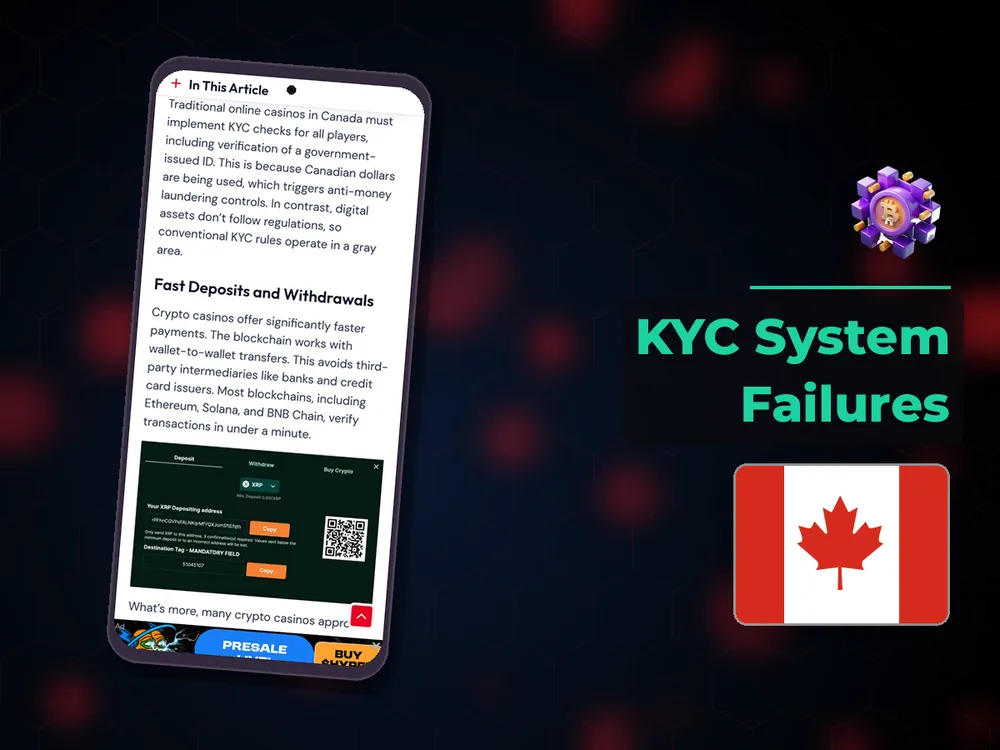
Know Your Customer (KYC) verification protocols were designed to combat money laundering and ensure legal gambling age compliance, but implementation created severe user experience problems for Canadian players. The standard process required uploading government-issued photo identification, proof of address (utility bill or bank statement), and sometimes additional documentation like selfies holding ID cards. Processing times ranged from 24 hours to two weeks, during which players could deposit funds but not withdraw winnings—creating an asymmetric risk where casinos held financial leverage over customers.
Privacy concerns represented the second major failure point. Canadian players were required to submit sensitive documents to offshore entities registered in jurisdictions like Malta, Curaçao, or Gibraltar, with limited legal recourse if data breaches occurred. High-profile incidents, including the 2022 breach of European casino operator Entain that exposed customer documents, validated these fears. For players in Canada where privacy regulations under PIPEDA (Personal Information Protection and Electronic Documents Act) set high standards, entrusting foreign gambling platforms with passport scans and home addresses felt inherently risky.
The system also created exclusion zones for legitimate players. Approximately 8-12% of Canadian adults lack traditional government-issued photo ID due to various socioeconomic factors, effectively barring them from regulated online gambling. Rural players in provinces like Manitoba or Saskatchewan faced additional friction—photographing documents with adequate resolution, dealing with file size limits, and navigating upload interfaces proved technically challenging for less digitally fluent demographics. KYC systems were optimized for compliance officers, not user experience, resulting in abandonment rates as high as 35% during the verification stage according to industry data from payment processor Nuvei.
| Verification Method | Average Processing Time | Document Requirements | Privacy Risk Level |
|---|---|---|---|
| Traditional KYC | 24-336 hours | Photo ID, Proof of Address, Selfie | High (offshore data storage) |
| No-KYC Crypto Casino | 0 hours (instant play) | None (wallet address only) | Low (pseudonymous blockchain record) |
| Hybrid Verification | 1-12 hours | Email, Phone, Optional ID for large withdrawals | Medium (tiered data collection) |
Dead-End Technologies: Altcoins That Never Caught On
The 2017-2021 cryptocurrency boom spawned dozens of gambling-specific tokens and payment solutions that promised to revolutionize casino transactions but ultimately failed to achieve meaningful adoption in the Canadian market. These failures provide instructive lessons about what features actually matter to players versus what sounds innovative in whitepapers. Three categories of dead-end technologies stand out: gambling-specific utility tokens, privacy coins with regulatory conflicts, and proof-of-stake casino platforms with unsustainable tokenomics.
Gambling utility tokens like FunFair (FUN), Wagerr (WGR), and Edgeless (EDG) launched with the premise that dedicated casino cryptocurrencies would offer superior gaming experiences through specialized blockchain features. FunFair, for example, built a custom “Fate Channel” technology for off-chain game state management, theoretically enabling faster gameplay than Ethereum’s base layer. The fatal flaws became apparent within two years: these tokens required players to first acquire Bitcoin or Ethereum, then execute a secondary exchange transaction to obtain the gambling token—adding friction rather than removing it. Canadian players showed clear preference for established cryptocurrencies with deep liquidity and acceptance across multiple platforms. By 2023, FunFair’s market capitalization had declined 98% from its peak, and most gambling-specific tokens were delisted from major exchanges.
Privacy coins represented the second category of failed adoption. Monero (XMR) and Zcash (ZEC) offered genuine cryptographic privacy features superior to Bitcoin’s pseudonymity—transactions were genuinely untraceable rather than merely pseudonymous. Several crypto casinos serving Canadian players added these options between 2018-2020, anticipating demand for maximum anonymity. However, regulatory pressure created existential risks for platforms accepting privacy coins. Canadian cryptocurrency exchanges including Bitbuy and Coinsquare delisted privacy coins under pressure from FINTRAC (Financial Transactions and Reports Analysis Centre of Canada), making it difficult for players to acquire these tokens through legitimate channels. More critically, casinos discovered that accepting privacy coins attracted regulatory scrutiny and payment processor restrictions that threatened their entire operation—the juice wasn’t worth the squeeze. By 2024, over 80% of crypto casinos had removed privacy coin options, standardizing on Bitcoin, Ethereum, Litecoin, and USDT stablecoins.
The third dead-end involved proof-of-stake casino platforms that attempted to blend gambling with cryptocurrency yield farming. Projects like CasinoCoin (CSC) and DAO.Casino promised players could earn passive income by staking tokens to power casino infrastructure while enjoying gambling services. The tokenomics model proved fundamentally unsustainable: promised annual percentage yields of 20-40% could only be funded through continuous new player deposits—a Ponzi-like structure that collapsed when user acquisition costs exceeded revenue. Canadian players who participated in these platforms between 2019-2021 experienced token value declines of 85-99%, learning the hard lesson that legitimate casinos profit from house edge on games, not speculative token appreciation. The survivors in the Canadian crypto casino market are those that treated cryptocurrency purely as a payment rail—a means to deposit and withdraw—rather than a speculative investment vehicle conflated with gambling.
What Are the Pros and Cons of No KYC Crypto Casinos?
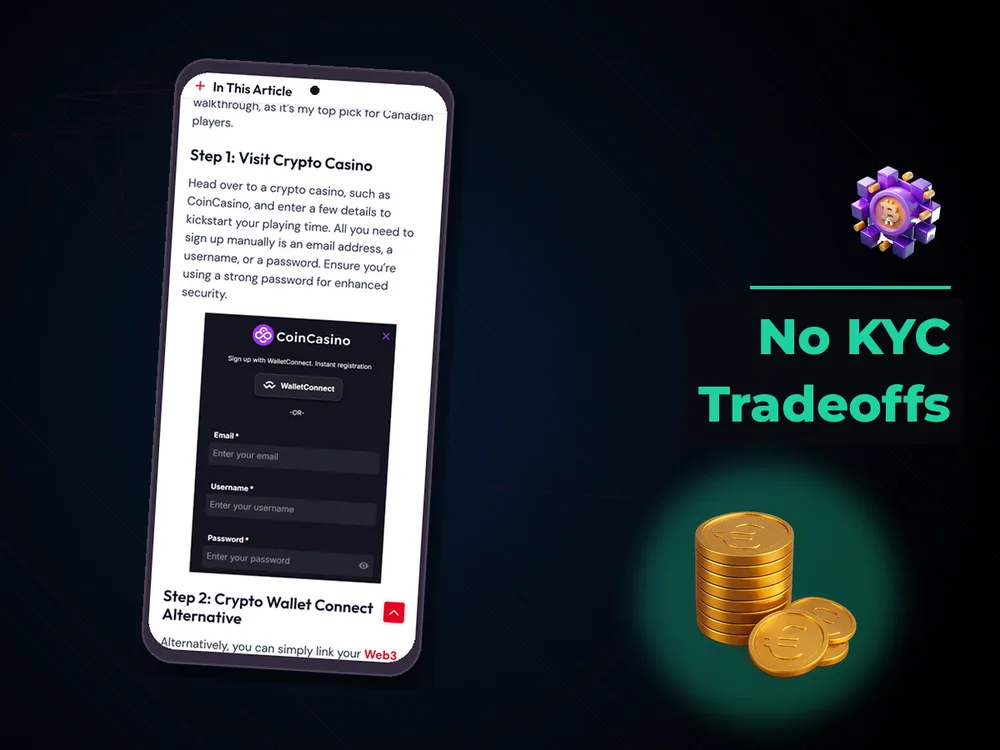
No KYC crypto casinos represent a fundamental trade-off in online gambling: maximizing user privacy and access speed while accepting reduced regulatory oversight and potential vulnerability to exploitation. For Canadian players, these platforms offer immediate access without document submission, withdrawal processing in minutes rather than days, and protection of personal information from data breaches. However, the absence of identity verification creates legitimate concerns around responsible gambling enforcement, underage access prevention, and limited legal recourse when disputes arise. Understanding this balance requires examining each dimension systematically—privacy versus accountability, speed versus security, and convenience versus consumer protection. The optimal choice depends heavily on individual player priorities: high-stakes players moving significant funds may prefer regulated platforms with formal dispute resolution mechanisms, while recreational players making small deposits often prioritize the frictionless experience no-KYC platforms provide.
Privacy vs. Regulation: The Strongest Argument Against Anonymous Play
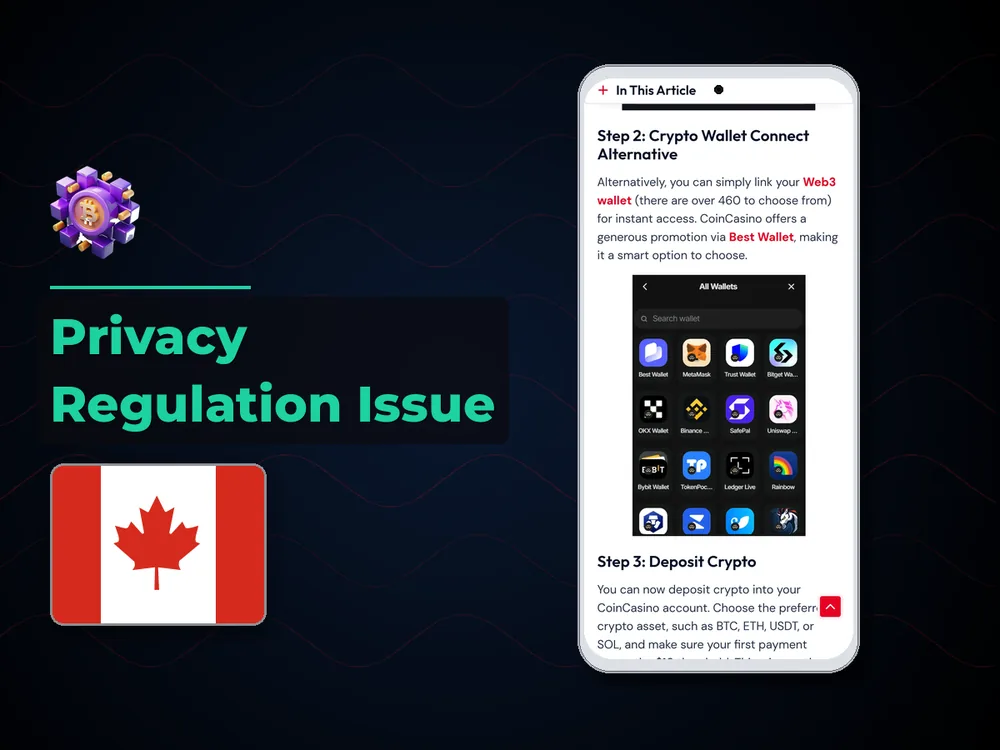
The strongest ethical and practical argument against no-KYC crypto casinos centers on the deliberate circumvention of safeguards designed to protect vulnerable populations. Traditional KYC systems, despite their friction and privacy costs, serve three critical functions that anonymous platforms cannot replicate: prevention of underage gambling, enforcement of self-exclusion programs, and detection of problem gambling patterns through behavioral monitoring. In Canada, where provinces operate responsible gambling programs like GameSense in Ontario and Mise-o-jeu in Quebec, the absence of identity verification fundamentally undermines harm reduction infrastructure.
Consider the concrete mechanics of how KYC-free operations enable harm. A problem gambler in Ottawa who has voluntarily enrolled in a self-exclusion program through the Ontario Lottery and Gaming Corporation cannot be prevented from accessing a no-KYC crypto casino—the platform has no mechanism to cross-reference the player’s identity against exclusion databases. Similarly, a 17-year-old with access to cryptocurrency can deposit and gamble without age verification, circumventing protections that are legally mandated in all Canadian provinces. Research from the Responsible Gambling Council indicates that approximately 2.6% of Canadian adults meet criteria for problem gambling, with earlier age of gambling initiation correlating strongly with addiction severity. No-KYC platforms remove the primary checkpoint that could interrupt this trajectory.
The regulatory argument extends beyond individual harm to societal costs. Anti-money laundering frameworks established under FINTRAC regulations require financial service providers to verify customer identities specifically to prevent illicit funds from entering the legitimate economy through gambling transactions. Cryptocurrency’s pseudonymous nature already complicates enforcement—layering anonymous gambling on top creates a nearly untraceable pathway for washing illegally obtained funds. While the percentage of crypto casino volume attributable to money laundering remains unknown due to the opacity involved, financial crime investigators consistently identify unregulated gambling as a high-risk vector. From this perspective, no-KYC casinos aren’t neutral technology platforms but active participants in enabling financial crime.
The counterargument deserves full articulation: privacy advocates contend that requiring identity disclosure for recreational activities sets a dangerous precedent where adult autonomy is subordinated to paternalistic control systems. They point out that physical casinos in Montreal or Vancouver don’t require passport scanning for entry—the KYC double standard applied to online gambling reflects not principled policy but the ease of implementing digital surveillance. Furthermore, the track record of data breaches at gambling companies (including the 2023 BetMGM incident exposing 1.5 million customer records) demonstrates that centralized identity databases create honeypots for cybercriminals. In this framing, no-KYC casinos aren’t evading reasonable regulation but resisting a surveillance regime that has repeatedly proven itself incapable of protecting the sensitive data it demands.
| Protection Mechanism | KYC Casino Implementation | No-KYC Casino Status | Impact on Canadian Players |
|---|---|---|---|
| Underage Access Prevention | Mandatory government ID verification (18+ or 19+ depending on province) | Not enforceable (cryptocurrency access only barrier) | Potential access for minors with crypto wallets |
| Self-Exclusion Programs | Integration with provincial databases (OLGA, BCLC systems) | No cross-referencing capability | Problem gamblers cannot be systematically blocked |
| Anti-Money Laundering | Transaction monitoring and FINTRAC reporting for suspicious activity | No identity linkage for reporting | Potential use for laundering illicit funds |
| Dispute Resolution | Verified identity enables legal claims and regulator complaints | Pseudonymous status limits legal recourse | Reduced consumer protection in case of platform fraud |
| Data Privacy Protection | Risk of breach exposing personal documents and financial info | Minimal personal data collected (wallet address only) | Lower breach risk but no KYC data to protect |
Transaction Speed: Instant Crypto vs. Bank Transfer Delays
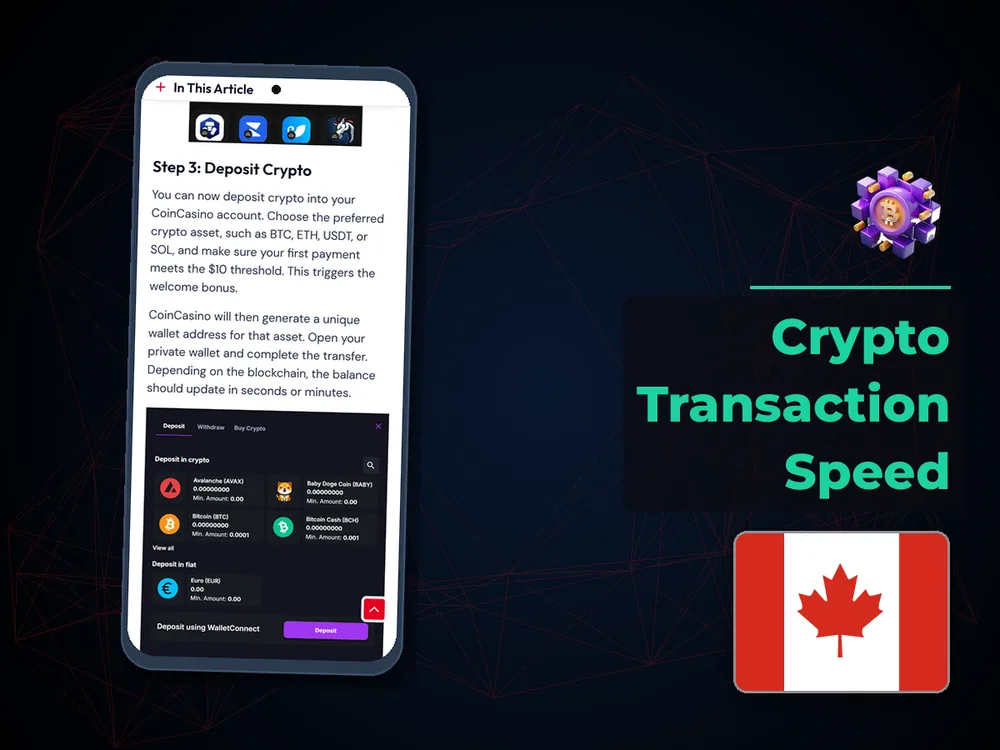
Transaction velocity represents the most tangible and quantifiable advantage of cryptocurrency casinos over traditional fiat platforms, with implications that extend beyond mere convenience to fundamentally alter risk dynamics and player behavior. A Bitcoin withdrawal from a no-KYC crypto casino typically confirms within 10-30 minutes depending on network congestion and the fee paid by the platform, while Ethereum transactions average 2-5 minutes, and networks like Litecoin or Bitcoin Cash often complete in under 3 minutes. This contrasts starkly with conventional online casinos serving Canadian players, where withdrawal processing involves multiple stages: internal platform review (24-72 hours), payment processor handling (1-2 business days), and bank settlement (1-3 additional business days), totaling 3-7 days for most players.
The speed differential creates practical consequences for bankroll management and session discipline. With instant withdrawals, a player who wins CAD 2,000 at a crypto casino can withdraw funds immediately, removing the temptation to continue playing and potentially losing back winnings—a phenomenon gambling psychology research identifies as a primary mechanism of loss-chasing behavior. Traditional casinos exploit withdrawal delays through what industry insiders call “reversal windows,” periods during which players can cancel pending withdrawals and return funds to their gaming balance. Data from UK Gambling Commission studies indicates that 15-30% of withdrawal requests at traditional online casinos are reversed by players during processing delays, with the majority of reversed funds ultimately lost back to the house. Instant cryptocurrency settlements eliminate this exploitation vector entirely.
Network-specific performance variations matter significantly for Canadian players. Bitcoin’s popularity creates congestion during high-usage periods, occasionally pushing confirmation times beyond one hour when transaction fees are insufficient. Ethereum’s gas fee model introduces volatility—the same transaction might cost CAD 2 during off-peak hours but CAD 40 during network congestion spikes. This has driven crypto casinos to adopt Layer 2 solutions and alternative blockchains. Polygon (MATIC) withdrawals cost under CAD 0.10 and confirm in approximately 2 seconds, while Binance Smart Chain offers similar speed at fractional costs. The Lightning Network for Bitcoin, though less widely adopted, enables near-instant settlements at fees below CAD 0.01 by handling transactions off the main blockchain and settling batches periodically.
Deposit speed advantages prove equally significant. A player in Toronto wanting to capitalize on a live betting opportunity can transfer cryptocurrency from a wallet to a casino account with single-block confirmation, often within 10 minutes for Bitcoin or 2 minutes for Ethereum. Traditional deposits via Interac e-Transfer—the dominant method for Canadian online gambling—require 30 minutes to 24 hours depending on the player’s bank and the casino’s payment processor. Credit card deposits are faster (2-5 minutes typically) but carry higher decline rates and trigger anti-gambling blocks at conservative Canadian banks. For time-sensitive scenarios like live dealer games or sports betting on events about to start, cryptocurrency’s settlement speed provides a structural competitive advantage that no traditional payment method can match.
Security Trade-offs: What You Gain and Risk Without Verification
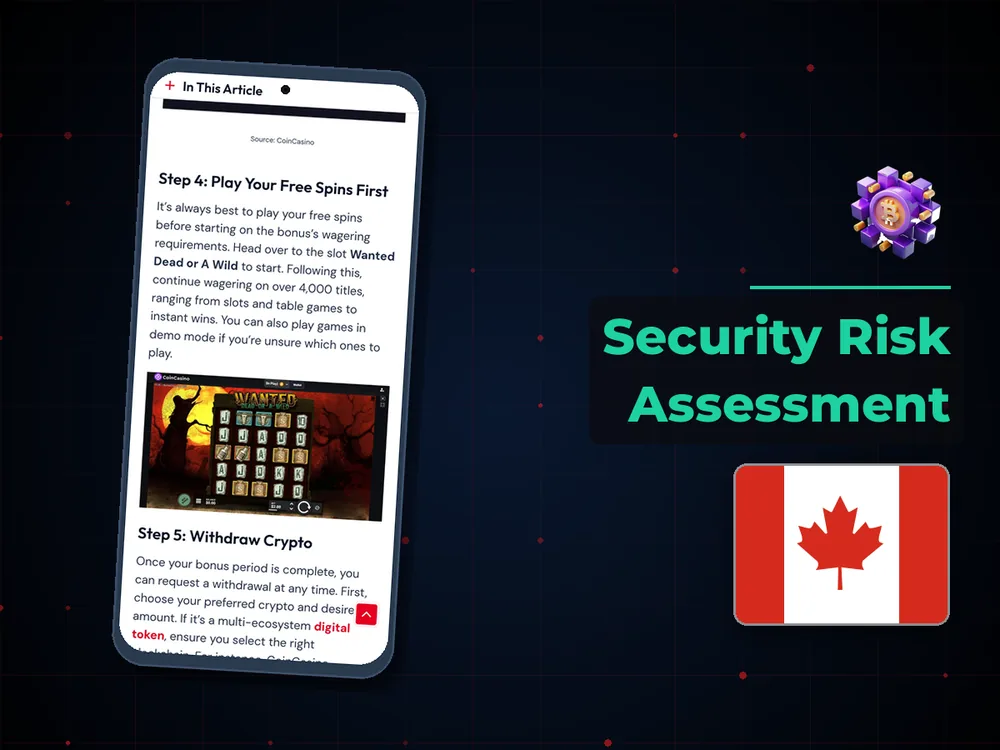
The security calculus for no-KYC crypto casinos involves asymmetric trade-offs where gains in certain threat categories come at the cost of increased vulnerability in others. Players gain protection against identity theft, data breach exposure, and financial surveillance while accepting elevated risks of platform fraud, unrecoverable losses from exit scams, and zero legal recourse in jurisdictions where anonymous gambling lacks regulatory recognition. Understanding these trade-offs requires examining the threat model from multiple angles: data security, platform reliability, transaction integrity, and regulatory protection.
On the data security front, no-KYC platforms offer substantial advantages. By collecting only a cryptocurrency wallet address and optional email contact, these casinos minimize their attack surface for data breaches. When traditional casinos experience security incidents—as occurred with DraftKings in 2023 affecting 67,000 accounts—compromised information includes names, addresses, dates of birth, and partial payment card numbers that enable identity theft. No-KYC platforms simply don’t possess this data to be stolen. For Canadian players particularly concerned about privacy given the country’s cross-border data flow to U.S. servers and the persistent risk of government access requests, this represents meaningful protection. The blockchain record of transactions is public but pseudonymous—observers can see that wallet address “1A1zP1eP5QGefi2DMPTfTL5SLmv7DivfNa” won 0.5 BTC, but without additional information cannot link that wallet to a person’s identity.
Platform reliability risks counterbalance these privacy gains. No-KYC crypto casinos operate predominantly in loosely regulated or unregulated jurisdictions—Curaçao licensing being the most common framework, which requires minimal capitalization and provides limited operational oversight. This regulatory arbitrage enables their no-verification business model but also removes safety nets. When a licensed casino in Ontario defaults on player balances, the Alcohol and Gaming Commission of Ontario (AGCO) can intervene, freeze assets, and potentially ensure players are made whole through regulatory reserve requirements. When an anonymous crypto casino executes an exit scam—collecting deposits then shutting down operations—players have virtually no recourse. The pseudonymous nature that protects player privacy simultaneously shields bad actors operating the platform.
Transaction integrity presents a nuanced picture. Cryptocurrency’s blockchain architecture provides cryptographic proof of deposits and withdrawals—a player can verify on a public block explorer like blockchain.com that funds left their wallet and arrived at the casino’s address. This transparency doesn’t exist with traditional payment methods where players must trust the casino’s internal accounting. However, this only covers the transaction layer, not game fairness. Provably fair gaming systems, implemented by sophisticated crypto casinos, use cryptographic commitments to prove games weren’t rigged—players can verify a hash of the game outcome was committed before they made their bet, preventing the platform from manipulating results. Yet many no-KYC casinos lack these implementations, running standard RNG games where fairness depends entirely on trusting the operator. Without regulatory audits or eCOGRA certifications common at licensed casinos, players at no-KYC platforms operate on pure trust—or more accurately, on the platform’s reputational incentive not to destroy its brand by cheating.
The legal recourse dimension deserves particular attention for Canadian players. While cryptocurrency gambling occupies a grey zone in Canada—not explicitly illegal under the Criminal Code but not formally regulated either—anonymity adds another layer of legal ambiguity. A player at a Kahnawake-licensed online casino operating with proper KYC can pursue disputes through the commission’s complaint process and potentially through Canadian courts, as the player-casino relationship has contractual elements and verified parties. At a no-KYC platform, the pseudonymous relationship may not constitute an enforceable contract under Canadian law—courts have struggled with cryptocurrency-related disputes specifically because of identification challenges. This means if a platform confiscates winnings citing terms of service violations or simply refuses withdrawal, the player’s practical legal options range from limited to nonexistent. The very anonymity that protects privacy eliminates accountability mechanisms.
| Security Dimension | No-KYC Advantage | No-KYC Disadvantage | Risk Severity for Canadian Players |
|---|---|---|---|
| Personal Data Protection | No identity documents stored; minimal breach exposure | No verification means weak account recovery if wallet access lost | Low (data breach risk eliminated) |
| Platform Fraud Risk | Blockchain transaction transparency; verifiable deposits | Exit scams possible; no regulatory capital requirements | High (no safety net for platform default) |
| Game Fairness Verification | Provably fair systems enable cryptographic outcome verification | Many no-KYC casinos lack provably fair implementation | Medium (depends on specific platform integrity) |
| Legal Recourse Options | Reduced personal exposure in disputes | Pseudonymous status complicates legal claims and regulator complaints | High (effectively no enforceable consumer protection) |
| Financial Surveillance | No bank transaction flags; FINTRAC reporting circumvented | Potential criminal liability if used for money laundering | Medium (depends on fund sources and transaction patterns) |
The optimal security posture depends on player risk tolerance and priorities. A recreational player depositing CAD 50-200 per session faces minimal downside risk—the worst-case scenario of a platform disappearing costs less than a night out in downtown Ottawa. For this profile, no-KYC platforms offer strong net security benefits through privacy protection and speed without proportional increase in material risk. Conversely, a high-stakes player managing a bankroll of CAD 10,000-50,000 operates in a fundamentally different risk environment where platform solvency and legal recourse mechanisms become critical. Such players should strongly consider licensed, KYC-compliant platforms despite privacy trade-offs, as the catastrophic risk of an exit scam or arbitrary fund seizure outweighs convenience benefits. The security trade-off is not universally favorable or unfavorable—it’s a risk profile match between platform characteristics and individual player circumstances.
Which Crypto Casino Offers the Best Bonus Structure in Ottawa?
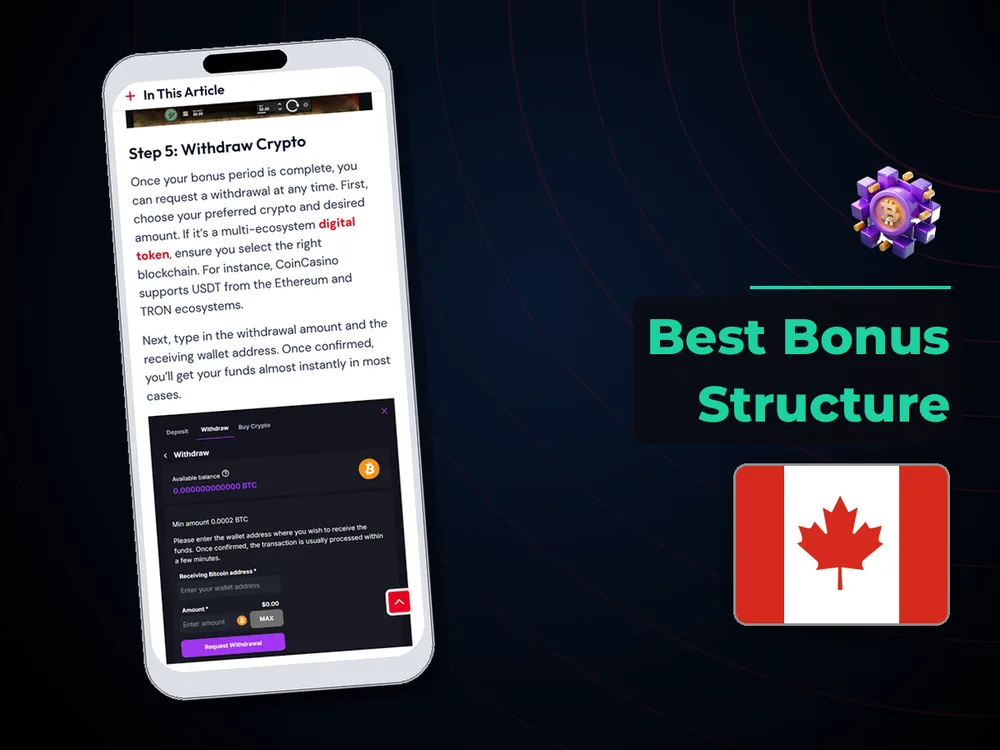
Evaluating crypto casino bonuses requires looking beyond headline percentages to examine the complete economic structure—wagering requirements, game contribution rates, maximum bet limits, time restrictions, and withdrawal conditions that determine actual player value. For Ottawa-based players, the best bonus structure balances three factors: realistic wagering multipliers (ideally 25-35x rather than 50-60x), transparent terms without hidden restrictions, and cryptocurrency-specific advantages like faster bonus clearing through provably fair games. The promotional landscape in 2026 shows significant variation: some platforms offer 300% deposit matches with punishing 60x wagering requirements that statistically ensure players lose the bonus before clearing it, while others provide modest 100% matches at 25x wagering that deliver genuine value. Understanding the mathematics behind bonus structures reveals why casinos offer them—they’re customer acquisition costs disguised as generosity, profitable for the house when designed correctly, but genuinely valuable to informed players who select offers with favorable clearing conditions and disciplined bankroll management.
No Deposit Bonuses: How to Claim Free Cryptocurrency

No deposit bonuses represent the purest form of risk-free gambling promotion: cryptocurrency credited to a player’s account without requiring any initial deposit, allowing genuine play with zero financial commitment. For Canadian players in Ottawa exploring crypto casinos for the first time, these offers provide an ideal testing ground to evaluate platform quality, game selection, and withdrawal processes before committing funds. The typical no deposit bonus in the crypto casino space ranges from 0.0005 BTC to 0.002 BTC (approximately CAD 40-160 at 2026 exchange rates), or equivalent amounts in alternative cryptocurrencies like 0.02 ETH or 20 USDT. These promotions serve dual purposes: attracting new users to platforms in a competitive market, and converting curious visitors into depositing players once they experience the platform’s interface and game library.
The claiming process follows a standardized pattern across most crypto casinos, though specific implementation varies by platform. The fundamental steps are:
- Registration: Create an account using an email address or social login. No-KYC platforms require only email verification, while some may request a phone number for SMS confirmation to prevent multi-account abuse. Use a dedicated email for gambling registrations to manage promotional communications separately from personal correspondence.
- Bonus activation: The no deposit bonus typically requires entering a promotional code during registration or claiming it from a promotions page after account creation. Common code formats include “NODEPOSIT2026,” “FREECRYPTO,” or “BITCOIN25.” Some platforms activate the bonus automatically upon email verification.
- Wagering completion: This represents the critical phase where most players fail to extract value. The bonus amount must be wagered a specified number of times—typically 30-50x for no deposit offers, meaning a 0.001 BTC bonus with 40x wagering requires 0.040 BTC in total bet volume before withdrawal becomes possible.
- Withdrawal: Upon meeting wagering requirements, players can withdraw winnings up to a maximum cap, usually 5-10x the original bonus amount. A 0.001 BTC no deposit bonus might allow maximum withdrawal of 0.005-0.010 BTC regardless of actual winnings achieved during the wagering process.
Critical restrictions determine whether no deposit bonuses deliver genuine value or function as marketing theater. Maximum bet limits during wagering typically cap individual bets at 0.00005-0.0001 BTC (CAD 4-8) to prevent players from making high-variance bets that could quickly clear requirements through a lucky win. Game contribution rates vary dramatically—slots usually contribute 100% of wagered amounts toward clearing requirements, while table games like blackjack or roulette often contribute only 10-20% or are excluded entirely. This creates a mathematical trap for uninformed players: betting 0.001 BTC on blackjack at 10% contribution only clears 0.0001 BTC toward requirements, requiring 10x more volume than the same bet on slots.
Time limitations add urgency that benefits the casino by encouraging impulsive play. Most no deposit bonuses expire within 7-30 days of claiming, with any uncleared bonus and associated winnings voided at expiration. This deadline pressure increases the likelihood of players making suboptimal strategic decisions or depositing their own funds to continue play after becoming invested in the platform. Sophisticated players recognize this psychological mechanism and approach no deposit bonuses with predetermined stop-loss and time limits—treating them as free entertainment with lottery-like upside rather than reliable income sources.
Geographic restrictions particularly affect Canadian players. While crypto casinos generally accept international players due to their decentralized nature, specific bonus offers may exclude certain jurisdictions based on IP detection. Platforms operating with Curaçao licenses typically allow Canadian participation, but those with stricter European licenses (MGA, UKGC) often restrict bonuses to EU residents. Using VPN services to circumvent geographic restrictions violates virtually all casino terms of service and provides casinos with grounds to void winnings and confiscate funds—the savings from claiming a restricted bonus are vastly outweighed by the risk of account closure with a positive balance.
Wagering Requirements Decoded: Hidden Costs Casinos Don’t Advertise
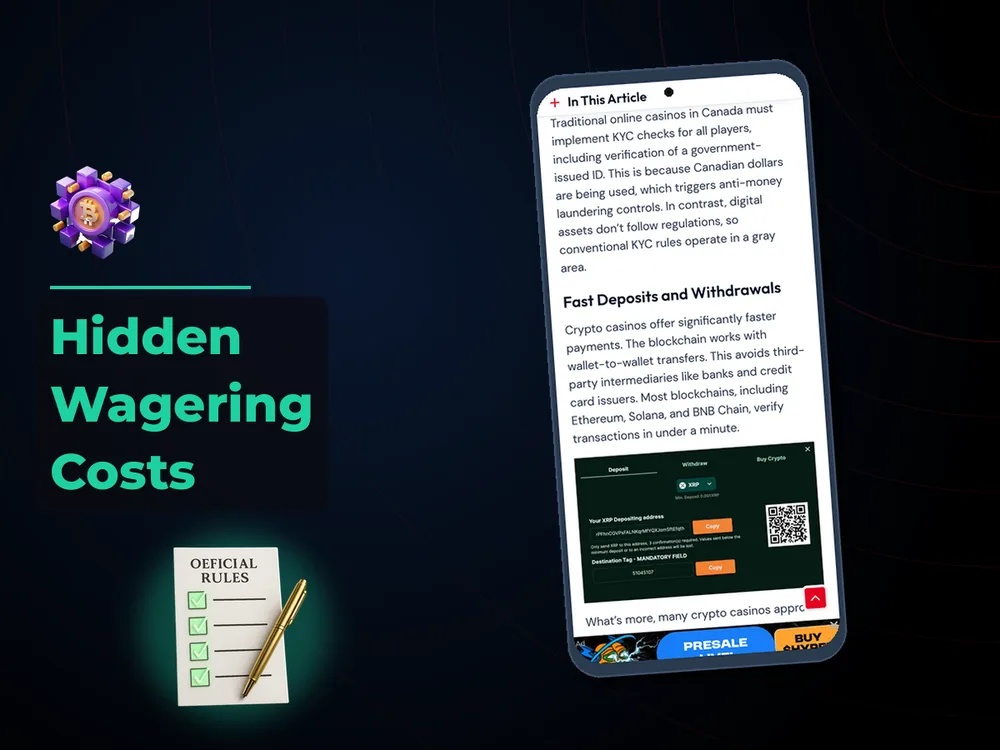
Wagering requirements represent the fundamental economic mechanism through which casinos profit from bonus promotions while maintaining the marketing appeal of “free money.” The requirement specifies how many times a player must wager the bonus amount (and sometimes the deposit amount as well) before converting bonus funds into withdrawable cryptocurrency. A 100% deposit match bonus up to 0.01 BTC with 35x wagering means a player depositing 0.01 BTC receives 0.01 BTC in bonus, creating a 0.02 BTC total balance, but must wager 0.35 BTC (35 × 0.01 BTC bonus) before withdrawal becomes possible. The mathematical reality is stark: at typical house edge rates of 2-5% depending on game selection, clearing 0.35 BTC in wagering will statistically cost the player 0.007-0.0175 BTC in expected losses—meaning the “free” bonus actually costs 70-175% of its face value to extract.
The hidden costs compound through multiple mechanisms that casinos structure into terms and conditions without prominent disclosure. Game weighting creates the first trap: as mentioned earlier, slots contribute 100% while blackjack might contribute 10% and video poker 5% or be excluded entirely. A player attempting to clear requirements through blackjack—which offers the lowest house edge when played with optimal strategy—faces a requirement effectively 10x larger than headline wagering multiples suggest. If they wager 0.35 BTC on blackjack at 10% contribution, only 0.035 BTC counts toward clearing the 0.35 BTC requirement, necessitating 3.5 BTC in actual wagers. At blackjack’s approximately 0.5% house edge with perfect basic strategy, this still creates expected losses of 0.0175 BTC, making the “bonus” economically neutral at best.
Maximum bet restrictions during bonus clearing serve dual purposes: preventing bonus abuse through high-variance strategies and increasing the time required to clear requirements, which elevates the probability of player error or abandonment. A typical restriction caps bets at 0.0001 BTC (approximately CAD 8) while clearing a bonus. For a player needing to wager 0.35 BTC, this minimum of 3,500 individual bets creates substantial time investment—approximately 15-20 hours of continuous play depending on game speed. The extended clearing period increases variance risk (short-term luck swings can deplete the bankroll before requirements are met) and psychological fatigue that leads to mistakes like exceeding maximum bet limits, which often void the entire bonus and all winnings derived from it.
Time limits create artificial urgency that statistically favors the house. A 30-day expiration on a bonus requiring 0.35 BTC in wagering necessitates clearing approximately 0.0117 BTC per day—a pace that demands regular play sessions and discourages disciplined bankroll management. Players who attempt to clear requirements in compressed timeframes make strategic errors and chase losses, behaviors that elevate house edge beyond theoretical minimums. Research in gambling psychology indicates time pressure increases risk-taking behavior and reduces decision quality, which is precisely why casinos implement these restrictions rather than allowing indefinite clearing periods.
Withdrawal caps represent the final hidden cost mechanism. Many crypto casino bonuses, particularly high-percentage matches, limit maximum withdrawals to 5-10x the bonus amount regardless of actual winnings. A player who receives a 0.01 BTC bonus, clears all wagering requirements, and wins 0.05 BTC through fortunate variance discovers they can only withdraw 0.05-0.10 BTC maximum, with excess winnings confiscated. This creates an asymmetric payoff structure: the casino faces capped downside (maximum payout per bonus is predetermined) while the player faces unlimited downside (can lose entire deposit and bonus) but capped upside. From an expected value perspective, withdrawal caps reduce bonus value by 15-30% depending on the player’s game selection and risk profile.
| Bonus Element | Player-Friendly Standard | Predatory Standard | Impact on Expected Value |
|---|---|---|---|
| Wagering Multiplier | 25-35x bonus amount only | 50-60x bonus + deposit | Predatory structure increases expected loss by 200-300% |
| Game Contribution | Slots 100%, Table Games 50% | Slots 100%, Table Games 0-10% | Forces suboptimal game selection, adds 3-5% to effective house edge |
| Maximum Bet Limit | 2-5% of bonus amount | 0.5-1% of bonus amount | Extends clearing time 4-10x, increases abandonment probability |
| Time Restriction | 60-90 days or no limit | 7-14 days | Creates pressure that elevates decision errors by 15-25% |
| Withdrawal Cap | No cap or 20x+ bonus | 5-10x bonus amount | Reduces upside potential by 20-35% through win confiscation |
The mathematics of bonus value calculation reveals when offers genuinely benefit players versus functioning as disguised marketing costs. A useful formula for expected bonus value considers: (Bonus Amount) × (1 - (Wagering Requirement × Average House Edge)) - (Time Value + Error Risk Premium). For a 0.01 BTC bonus with 30x wagering on 2% house edge slots: 0.01 × (1 - (30 × 0.02)) = 0.01 × (1 - 0.6) = 0.004 BTC expected value. This positive expected value makes the bonus worthwhile—but only if the player successfully clears requirements without violating terms. Factoring in a 20% probability of term violation or abandonment reduces expected value to 0.0032 BTC, still positive but marginal relative to the time investment required.
1Win vs. Top Competitors: Bonus Value Comparison
The 1Win crypto casino positions itself in the Canadian market with a bonus structure emphasizing high percentage matches and cryptocurrency-specific promotions, competing directly against established platforms like Stake.com, BC.Game, and BitStarz. Analyzing the comparative value requires examining not just headline bonus percentages but the complete economic package: wagering requirements, game restrictions, clearing timeframes, and the reliability of withdrawal processing once requirements are met. For Ottawa players specifically, factors like Bitcoin versus altcoin bonus availability and the platform’s track record with Canadian customer support become decision-relevant variables.
1Win’s primary welcome bonus offers a 500% match on first deposits up to 0.01 BTC (approximately CAD 800 at 2026 exchange rates), positioning it at the aggressive end of the promotional spectrum. This means a 0.002 BTC deposit yields 0.012 BTC total balance (original 0.002 BTC plus 0.01 BTC bonus). The associated wagering requirement stands at 40x the bonus amount, translating to 0.4 BTC in required wagering before withdrawal. Game contribution follows industry standards: slots at 100%, live casino games at 10%, and table games like blackjack largely excluded. Maximum bet during clearing is capped at 0.00012 BTC (approximately CAD 10), and the bonus expires after 30 days. Withdrawal caps limit maximum payout to 10x the bonus amount, meaning the 0.01 BTC bonus caps withdrawals at 0.1 BTC regardless of actual winnings achieved.
Stake.com, operating since 2017 and widely recognized in cryptocurrency gambling circles, employs a fundamentally different bonus philosophy. Rather than high-percentage deposit matches, Stake focuses on rakeback programs and VIP reward structures that return a percentage of wagered amounts regardless of win/loss outcomes. Their effective “bonus” for new players is a 200% deposit match up to 0.01 BTC with 35x wagering requirements—lower percentage but more achievable clearing conditions. The critical advantage lies in Stake’s ongoing rakeback: players receive 10% weekly cashback on net losses, which doesn’t carry additional wagering requirements. For sustained players, this structure often delivers superior lifetime value compared to front-loaded deposit bonuses, though it lacks the immediate gratification of a 500% match.
BC.Game differentiates through cryptocurrency diversity, offering deposit bonuses in over 50 different cryptocurrencies including Bitcoin, Ethereum, Litecoin, Dogecoin, and numerous altcoins. Their welcome package provides a 270% match across the first four deposits (rather than a single large bonus), totaling up to 1.2 BTC in bonus funds. Wagering requirements sit at 40x the bonus amount with 30-day expiration, similar to 1Win. The distinctive feature is BC.Game’s “Lucky Spin” system, which adds a gamification layer where bonus funds can be used to spin a wheel for additional prizes including NFTs and higher-tier VIP status. For players interested in cryptocurrency culture beyond pure gambling, this ecosystem approach offers intangible value that pure bonus mathematics don’t capture.
BitStarz, licensed in Curaçao and operating since 2014, represents the establishment option with a track record of reliable withdrawals and responsive customer service. Their welcome package offers a more conservative 100% match up to 0.02 BTC plus 180 free spins distributed over the first four deposits. Wagering requirements are set at 40x, consistent with competitors, but BitStarz distinguishes itself through faster bonus clearing—slots contribute 100%, and most table games contribute 40-50% rather than the 0-10% common elsewhere. This makes BitStarz bonuses more valuable for players who prefer blackjack or roulette over slots, as the effective wagering requirement is cut by 50-60% for these games. The trade-off is lower headline percentages that appear less attractive in marketing comparisons but deliver better realized value for strategic players.
| Platform | Welcome Bonus Structure | Wagering Requirement | Table Game Contribution | Effective Value (0.01 BTC deposit) |
|---|---|---|---|---|
| 1Win | 500% match up to 0.01 BTC | 40x bonus amount | 0-10% (mostly excluded) | 0.006 BTC (considering 2% slot edge, 0.4 BTC clearing volume) |
| Stake.com | 200% match up to 0.01 BTC + 10% weekly rakeback | 35x bonus amount | 15% (limited games) | 0.008 BTC (bonus) + 0.002 BTC (monthly rakeback estimate) = 0.010 BTC |
| BC.Game | 270% across 4 deposits, up to 1.2 BTC total | 40x bonus amount | 10% (standard exclusions) | 0.007 BTC (for first deposit; improves with full package usage) |
| BitStarz | 100% match up to 0.02 BTC + 180 free spins | 40x bonus amount | 40-50% (blackjack, roulette) | 0.009 BTC (higher table game contribution improves clearing probability) |
Expected value calculations accounting for clearing probability and house edge reveal counterintuitive results. The 1Win 500% bonus, despite its impressive headline figure, delivers approximately 0.006 BTC in expected value for a 0.01 BTC deposit when accounting for the 0.4 BTC wagering requirement at 2% average house edge (0.01 BTC bonus × 0.6 after house edge costs). Stake’s lower 200% bonus but superior long-term rakeback structure yields approximately 0.010 BTC expected value over the first month of play when combining initial bonus with ongoing cashback. BitStarz’s 100% bonus with improved table game contribution delivers 0.009 BTC expected value due to higher clearing success rates and lower effective house edge for strategic players. BC.Game falls in the middle at 0.007 BTC, with the caveat that their multi-deposit structure requires sustained engagement to realize full value.
For Ottawa players making platform selection decisions, the optimal choice depends on playing style and session frequency. Recreational players making occasional 0.001-0.005 BTC deposits benefit most from 1Win’s aggressive first-deposit bonus despite its challenging clearing conditions—even partial clearing provides value, and the large bonus amount extends playing time. Serious players depositing 0.01-0.05 BTC regularly should prioritize Stake’s rakeback structure, which delivers consistent value without the variance and time pressure of bonus clearing. Strategy-focused players who prefer blackjack or video poker over slots should strongly consider BitStarz due to the superior table game contribution rates that make bonuses actually clearable for these game types. Cryptocurrency enthusiasts interested in the broader digital asset ecosystem may find BC.Game’s NFT integration and altcoin diversity worth the marginal bonus value disadvantage.
Withdrawal reliability represents the final comparison dimension often overlooked in bonus analysis. The most generous bonus structure becomes worthless if the platform delays or denies withdrawals after requirements are met. Community feedback from sources like Reddit’s r/CryptoCasinos and Bitcointalk forums consistently ranks Stake and BitStarz at the top for withdrawal reliability, with numerous reports of five-figure Bitcoin withdrawals processed within 30 minutes. 1Win and BC.Game show more variable performance—mostly positive but with occasional reports of delayed withdrawals requiring customer support intervention. For players planning to clear large bonuses and withdraw significant amounts, the established track record of Stake and BitStarz justifies accepting lower headline bonus percentages in exchange for withdrawal certainty.
How Do You Choose a Secure Crypto Casino for Canadian Players?
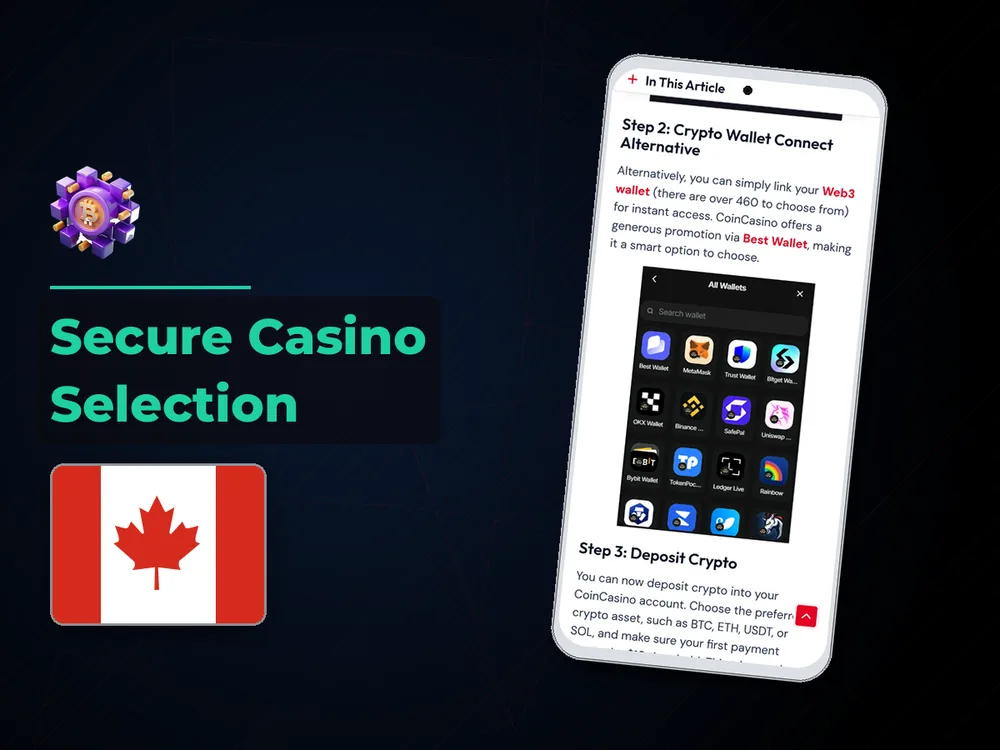
Selecting a secure crypto casino requires systematic evaluation across multiple dimensions that collectively determine platform trustworthiness and player protection. For Canadian players in Ottawa navigating an unregulated cryptocurrency gambling landscape, security assessment cannot rely on government oversight or consumer protection agencies—instead, players must perform due diligence by examining technical security implementations, licensing credentials, operational transparency, and community reputation signals. The core evaluation framework centers on three critical questions: Can you cryptographically verify that games are fair rather than trusting the operator’s claims? Does the platform’s cryptocurrency infrastructure minimize counterparty risk through secure wallet architecture and transparent blockchain transactions? What regulatory and reputational signals indicate the platform will honor withdrawals and operate with integrity over multi-year timeframes? Platforms that excel across all three dimensions—provably fair gaming, robust cryptocurrency security, and credible regulatory positioning—represent the safest choices for Canadian players, while those failing any single criterion introduce unacceptable risk regardless of attractive bonuses or game selection.
Provably Fair Technology: Verifying Game Integrity on Blockchain
Provably fair gaming represents the most significant technological advancement cryptocurrency casinos offer over traditional online gambling platforms—the ability to cryptographically verify that individual game outcomes were determined fairly rather than manipulated by the operator. This technology fundamentally inverts the trust model: instead of players trusting third-party auditors like eCOGRA or iTech Labs to certify that a casino’s Random Number Generator produces fair results, provably fair systems allow each player to independently verify the fairness of every single bet they place using publicly auditable cryptographic methods. For Canadian players accustomed to the opacity of traditional online casinos where fairness is a matter of faith backed by distant regulatory authorities, provably fair technology provides mathematical certainty that is verifiable in real-time.
The technical mechanism operates through cryptographic commitment schemes, most commonly using SHA-256 hashing algorithms. Before a game round begins, the casino generates a random server seed—a long string of random characters that will determine the game outcome. The casino then creates a cryptographic hash of this server seed (a mathematical fingerprint that uniquely identifies the seed but doesn’t reveal its content) and displays this hash to the player before they place their bet or select their client seed (another random string the player contributes to the outcome generation). This commitment mechanism ensures the casino cannot change the server seed after seeing the player’s bet or client seed, as any alteration would produce a completely different hash value. After the game round completes, the casino reveals the original server seed, allowing the player to verify that its hash matches the pre-committed hash displayed before the bet.
The actual game outcome is generated by combining the server seed, client seed, and a nonce (a counter that increments with each bet) through a deterministic algorithm. For a dice game with outcomes from 0-100, the combined seeds might be processed through a hash function, with the resulting hexadecimal value converted to a decimal number in the 0-100 range. Because hash functions are deterministic (the same input always produces the same output) and the seeds were committed before the bet, neither party can manipulate the outcome. The casino cannot cheat because it committed to its server seed before knowing the player’s client seed, and the player cannot claim unfairness because they can verify the entire process using the revealed seeds and publicly documented algorithm.
Practical verification requires players to actively use verification tools rather than passively trusting the provably fair label. Reputable crypto casinos provide built-in verification interfaces where players can input the server seed, client seed, nonce, and game-specific parameters to recalculate outcomes and confirm they match actual results. Third-party verification tools like those available at provablyfair.com allow cross-platform verification—players can take seed data from any casino claiming provably fair operation and independently verify fairness using neutral calculators. For Ottawa players evaluating casino security, the verification workflow should be tested with real bets: place a small wager, record the pre-committed hash and all seeds, complete the game, then use the verification tool to confirm the outcome matches the cryptographic calculation.
Critical limitations of provably fair technology deserve equal attention. First, provably fair only applies to specific game categories—primarily dice, crash, plinko, and other simple outcome-based games. Traditional casino games like slots, blackjack, and roulette often cannot be made provably fair because their outcomes involve complex state (card positions in a shuffled deck, reel positions with weighted symbols) that cannot be efficiently committed and revealed. Some crypto casinos offer “provably fair slots” using simplified mechanics, but these differ substantially from the sophisticated slot games available at traditional casinos. Players seeking authentic slot or table game experiences may need to choose between provable fairness and game variety.
Second, provably fair systems only verify that the committed algorithm was followed—they don’t prove the algorithm itself is fair. A casino could implement a provably fair dice game where the conversion algorithm subtly biases outcomes toward the house beyond the stated house edge. This is why algorithm transparency matters: legitimate platforms publish their complete outcome generation code in open-source repositories on GitHub, allowing mathematically sophisticated players or third-party auditors to verify the statistical fairness of the algorithm itself. Platforms that claim provably fair operation but refuse to publish their algorithms should be treated with extreme suspicion—they’re likely hiding unfavorable outcome distributions within mathematically correct but biased implementations.
Third, server seed rotation policies affect the strength of fairness guarantees. Best practices require casinos to rotate server seeds frequently (after each bet or at least daily) and allow players to request immediate seed changes. Platforms that reuse the same server seed across thousands of bets create vulnerability—a sufficiently determined attacker with access to outcome data could potentially reverse-engineer patterns in the seed generation. While this represents an advanced threat beyond most player concerns, seed rotation frequency serves as a signal of technical sophistication and security consciousness. Ottawa players conducting security evaluations should verify that their chosen platform rotates seeds appropriately and provides clear documentation of seed lifecycle management.
| Game Type | Provably Fair Compatibility | Verification Complexity | Trust Requirement |
|---|---|---|---|
| Dice / Crash / Plinko | Fully compatible; native implementation | Simple (hash verification with basic calculator) | Minimal (full cryptographic verification possible) |
| Blackjack / Poker | Partially compatible with simplified mechanics | Moderate (deck shuffle verification requires understanding of Fisher-Yates algorithm) | Medium (must trust shuffle algorithm fairness) |
| Slots (traditional) | Not compatible; simulated provably fair versions differ significantly | Complex (weighted reel verification requires analyzing paytable math) | High (relies on operator integrity for outcome weighting) |
| Live Dealer Games | Not compatible; outcomes determined by physical processes | Not applicable (relies on video verification of physical cards/wheel) | High (requires trusting dealer and video stream integrity) |
Cryptocurrency Options: Bitcoin vs. Ethereum vs. Altcoins
The cryptocurrency selection a platform supports reveals critical information about its technical infrastructure, target market positioning, and operational priorities. For Canadian players, cryptocurrency choice impacts transaction speed, fee costs, privacy characteristics, and exposure to exchange rate volatility during the time funds remain in casino accounts. Bitcoin remains the dominant cryptocurrency for gambling due to its liquidity, widespread acceptance, and the extensive ecosystem of Canadian exchanges (Bitbuy, NDAX, Newton) that facilitate CAD-to-BTC conversion. However, Bitcoin’s network congestion and fee volatility create practical friction—transaction fees can spike to CAD 15-40 during periods of high network usage, making small deposits economically inefficient, while confirmation times occasionally extend to 60+ minutes when mempool backlogs occur.
Ethereum offers theoretical advantages in transaction speed and smart contract capabilities but introduces its own complications. Ethereum’s average block time of 12-15 seconds enables faster deposit confirmation compared to Bitcoin’s 10-minute blocks, reducing the waiting period between sending funds and having them credited to a casino account. However, Ethereum’s gas fee model creates extreme cost volatility—the same transaction that costs CAD 2 during off-peak hours might cost CAD 50 during network congestion, particularly when decentralized finance (DeFi) activity spikes. For Ottawa players, Ethereum makes most sense for larger deposits (0.05 ETH or more, approximately CAD 200+) where percentage fee impact remains tolerable, while Bitcoin proves more economical for smaller deposits once amortized across multiple transactions.
Litecoin and Bitcoin Cash emerged specifically to address Bitcoin’s scaling limitations and remain popular casino currencies due to their fast confirmation times (2.5 minutes for Litecoin, similar for Bitcoin Cash) and consistently low fees (typically under CAD 0.50 per transaction). These cryptocurrencies offer the sweet spot for most Canadian recreational players: fast enough for practical deposit/withdrawal cycles, cheap enough that fees don’t materially impact bankroll, and liquid enough that conversion to/from CAD remains straightforward through major Canadian exchanges. The trade-off is reduced acceptance—while major platforms like Stake, BC.Game, and BitStarz support Litecoin, smaller or newer casinos may offer Bitcoin and Ethereum only, requiring players to perform an additional exchange step if their holdings are primarily in alternative cryptocurrencies.
Stablecoins, particularly USDT (Tether) and USDC, provide exchange rate stability that addresses a primary concern for risk-averse players. When a Canadian player deposits 0.01 BTC worth CAD 800 and plays over several days, Bitcoin’s price volatility means their bankroll might be worth CAD 750 or CAD 850 when they withdraw—an additional layer of variance unrelated to gambling outcomes. Stablecoins eliminate this by pegging value to the US dollar (approximately CAD 1.35 per USDT accounting for exchange rates). For players who view gambling as entertainment with defined budgets rather than cryptocurrency speculation, stablecoins enable precise bankroll management. The limitation is that stablecoin transactions typically occur on Ethereum (ERC-20 tokens) or Tron (TRC-20 tokens), inheriting the fee structures and speed characteristics of those underlying blockchains.
Privacy-focused altcoins like Monero or Zcash theoretically offer enhanced anonymity but face significant practical limitations in the casino context. As discussed in the historical evolution section, regulatory pressure has largely eliminated privacy coins from reputable platforms, with most major crypto casinos removing support between 2020-2023. The remaining platforms accepting privacy coins tend to be smaller operations in regulatory grey zones, introducing platform risk that outweighs privacy benefits for most Canadian players. Additionally, acquiring privacy coins has become difficult—major Canadian exchanges delisted them under FINTRAC pressure, forcing players to use decentralized exchanges or peer-to-peer platforms that add complexity and counterparty risk.
Layer 2 solutions and alternative blockchain networks represent the current frontier in casino cryptocurrency adoption. Polygon (MATIC), a layer 2 scaling solution for Ethereum, offers transaction costs under CAD 0.10 and confirmation times around 2 seconds—combining the best characteristics of speed, cost, and smart contract capability. Binance Smart Chain provides similar performance with broader cryptocurrency ecosystem integration. Solana delivers even faster transactions but has experienced network outages that created temporary withdrawal delays at supporting casinos, highlighting the trade-off between cutting-edge performance and proven reliability. For Canadian players prioritizing transaction efficiency over maximum privacy or specific cryptocurrency holdings, platforms supporting multiple layer 2 options provide the most flexible and cost-effective experience in 2026.
The strategic consideration for Ottawa players is matching cryptocurrency choice to playing patterns and risk tolerance. High-frequency players making daily deposits and withdrawals should prioritize platforms supporting Litecoin, Polygon, or other low-fee, fast-confirmation options to minimize transaction cost impact on bankroll. Players making less frequent, larger deposits can tolerate Bitcoin or Ethereum fee structures in exchange for maximum liquidity and universal acceptance. Risk-averse players concerned about cryptocurrency volatility should favor platforms with robust stablecoin support, accepting the marginally higher fees of Ethereum-based tokens in exchange for price stability. Cryptocurrency enthusiasts holding diverse portfolios benefit from platforms supporting 10+ different cryptocurrencies, eliminating the need for exchange transactions and their associated fees and exchange rate spreads.
License Verification: What Regulatory Signals Matter in 2026
Cryptocurrency casino licensing exists in a fragmented global landscape where regulatory quality varies dramatically—from stringent European jurisdictions with meaningful consumer protection to offshore “licenses” that function as paid rubber stamps with no operational oversight. For Canadian players, license evaluation requires understanding what different regulatory regimes actually verify and enforce, distinguishing between licenses that provide genuine security signals versus those serving purely as marketing decoration. The fundamental challenge is that cryptocurrency gambling operates in a legal grey zone in Canada—not explicitly illegal under the Criminal Code’s gambling provisions, but not formally regulated by provincial authorities either. This creates a situation where players must rely on foreign regulatory frameworks of varying quality to assess platform legitimacy.
Curaçao licensing dominates the crypto casino landscape, with an estimated 70-80% of platforms accepting Canadian players operating under Curaçao e-Gaming licenses. This jurisdiction offers three critical advantages for operators: low licensing costs (approximately USD 10,000-50,000 annually), minimal operational requirements, and acceptance of cryptocurrency-focused business models that stricter jurisdictions prohibit or heavily restrict. The corresponding disadvantage for players is that Curaçao licensing provides limited consumer protection—the licensing authority does not maintain player compensation funds, dispute resolution is generally left to the operator’s discretion, and enforcement actions against problem operators are rare and slow. A Curaçao license signals that a platform has met basic registration requirements and paid licensing fees, but it does not verify financial stability, game fairness, or commitment to responsible gambling practices.
Practical verification of Curaçao licenses requires specific steps due to widespread license fraud in the industry. Legitimate Curaçao licenses display a validation seal linked to the licensing authority’s database where players can verify active license status. The verification process involves: locating the license number displayed in the casino’s footer (typically a format like “1668/JAZ” or similar), visiting the Curaçao Gaming Control Board website to access their license registry, and confirming the casino’s operating company name matches the licensed entity. Fraudulent operations frequently display fake license numbers or seals that link to nonexistent registries or cloned websites designed to appear official. Ottawa players should treat any casino that does not provide a verifiable license number with direct links to official registry databases as unlicensed and therefore high-risk.
Malta Gaming Authority (MGA) licenses represent a significant upgrade in regulatory quality and consumer protection, though they remain rare in the pure cryptocurrency casino space. MGA licensing requires operators to maintain segregated player funds in European banks, submit to regular financial audits, implement responsible gambling tools including deposit limits and self-exclusion, and participate in binding alternative dispute resolution processes through bodies like eCOGRA. The requirements make MGA licensing expensive (initial application fees exceed EUR 25,000 with substantial ongoing compliance costs) and operationally demanding, which is why most cryptocurrency-focused platforms avoid this jurisdiction. For Canadian players, an MGA-licensed casino provides the highest level of regulatory assurance available in the online gambling industry, but the trade-off is typically reduced cryptocurrency options and mandatory KYC verification that eliminates privacy benefits.
Costa Rica “licenses” warrant specific caution as they represent perhaps the most misleading regulatory signal in the industry. Costa Rica does not actually license or regulate online gambling—rather, it allows companies to incorporate and operate gambling businesses from Costa Rican territory without specific gambling oversight. Companies operating from Costa Rica often display official-looking “Costa Rica Licensed” seals, but these indicate only that a business is registered, not that any regulatory authority has verified its operations or provides player protections. For practical purposes, Canadian players should treat Costa Rica registration identically to completely unlicensed operations—while some Costa Rica-based platforms operate with integrity, the “license” itself provides zero security signal or recourse mechanism.
Gibraltar and United Kingdom Gambling Commission (UKGC) licenses represent the gold standard for regulatory oversight but are virtually unavailable to Canadian players in the crypto casino context. Both jurisdictions impose strict requirements including significant financial reserves, comprehensive responsible gambling implementations, and extensive reporting. However, both also maintain strict geographic restrictions—UKGC-licensed casinos generally cannot accept players outside approved jurisdictions, and Gibraltar licenses face similar constraints. Canadian players occasionally encounter these licenses at traditional online casinos offering cryptocurrency payment options, but pure crypto casinos serving Canadian markets overwhelmingly operate under less restrictive licenses. The licenses serve as useful comparison benchmarks for understanding what robust regulation looks like, even if they’re rarely accessible to Canadian players in practice.
Operational transparency signals often prove more valuable than license type for assessing platform security. Key indicators include: publication of company ownership and management team (platforms hiding behind anonymous shell companies introduce significant risk), disclosure of game providers and their licensing (legitimate operators use licensed game content from established providers like Pragmatic Play or Evolution Gaming rather than unlicensed clones), transparent terms of service with specific dispute resolution processes, and active presence on gambling community forums where player complaints receive responses. A Curaçao-licensed casino that publicly identifies its management team, maintains responsive customer support, and has operated for 3+ years with consistent positive community feedback provides stronger security signals than a newer platform with a technically superior license but anonymous ownership and pattern of unresolved player complaints.
| License Jurisdiction | Initial Cost to Operator | Player Protection Features | Crypto Casino Availability | Verification Method |
|---|---|---|---|---|
| Curaçao e-Gaming | USD 10,000-50,000 | Minimal; basic registration requirements only | Very High (70-80% of market) | License registry at Curaçao Gaming Control Board website |
| Malta Gaming Authority | EUR 25,000+ plus ongoing compliance | Strong; segregated funds, dispute resolution, audits | Low (strict crypto restrictions) | Public registry at mga.org.mt with detailed compliance records |
| Costa Rica | USD 1,000-5,000 (incorporation only) | None; no gambling-specific regulation | Medium (declining due to reputation) | Not applicable; business registration, not gambling license |
| UK Gambling Commission | GBP 100,000+ with substantial reserves | Very Strong; comprehensive consumer protection | Very Low (geographic restrictions exclude Canada) | Public register at gamblingcommission.gov.uk |
| Kahnawake Gaming Commission | CAD 50,000-100,000 estimated | Moderate; Canadian-based dispute resolution | Low (traditional online casinos primarily) | License verification through Kahnawake Gaming Commission website |
The Kahnawake Gaming Commission, based in the Mohawk territory of Kahnawake near Montreal, represents a uniquely Canadian licensing option that deserves specific mention. Established in 1996, Kahnawake was among the first jurisdictions to regulate online gambling and has licensed numerous platforms serving Canadian players—though primarily traditional online casinos rather than cryptocurrency-focused operations. Kahnawake licenses provide moderate regulatory oversight with the advantage of Canadian legal jurisdiction for dispute resolution, making enforcement more practical for Canadian players than pursuing claims against Curaçao or Malta entities. However, the commission has been slow to adapt to cryptocurrency gambling, and few pure crypto casinos hold Kahnawake licenses in 2026. For Ottawa players, Kahnawake-licensed platforms represent a middle ground—better regulatory positioning than Curaçao but without the comprehensive consumer protection of MGA or UKGC licenses.
The practical recommendation for Canadian players evaluating platform security through licensing is to establish minimum acceptable standards while recognizing that perfect regulatory oversight doesn’t exist in the cryptocurrency casino space. A reasonable standard for 2026 requires: verifiable Curaçao license minimum (with validation through official registries), operational history of at least 18-24 months demonstrating stability, transparent corporate structure with identifiable management, and positive community reputation with pattern of successful withdrawals. Platforms meeting these criteria while offering additional regulatory credentials (MGA, Gibraltar, or Kahnawake licensing) provide incremental security benefits, but the absence of premium licenses should not be disqualifying if other security signals are strong. Conversely, platforms failing to meet the minimum standard—unlicensed operations, new platforms with anonymous ownership, or those with patterns of withdrawal disputes—should be avoided regardless of attractive bonuses or game selection, as the catastrophic risk of fund loss outweighs any potential benefits.
What Do Reddit Communities Say About Top Crypto Casinos?
Reddit communities dedicated to cryptocurrency gambling—particularly subreddits like r/CryptoCasinos, r/btc, and r/gambling—serve as critical information sources where Canadian players share unfiltered experiences, expose fraudulent operations, and collectively identify trustworthy platforms through crowd-sourced verification. Unlike affiliate marketing websites that profit from casino referrals and therefore lack incentive to publish negative reviews, Reddit’s pseudonymous discussion format enables honest reporting of withdrawal delays, support failures, and terms of service disputes without fear of legal retaliation or financial consequences. For Ottawa-based players conducting due diligence, Reddit discussion threads provide three irreplaceable insights: real-world withdrawal timelines that reveal whether platforms actually deliver on their instant-withdrawal promises, support quality assessment during dispute scenarios when casinos have financial incentive to deny legitimate claims, and early warning systems for emerging scam operations before they accumulate sufficient victim reports to appear on formal blacklist databases. The collective intelligence of thousands of active gamblers creates a distributed fraud detection network more responsive than any centralized regulatory authority—patterns of concerning behavior identified and discussed on Reddit often precede formal regulatory action by months or years, giving informed players critical early warning to withdraw funds and avoid platforms showing distress signals.
Real User Experiences: Withdrawal Speed and Support Quality
Withdrawal speed represents the single most discussed metric in Reddit cryptocurrency casino communities, and for good reason—it serves as the ultimate test of platform integrity. The fundamental question every player needs answered is: when I win and request withdrawal, will I actually receive my funds, and how quickly? Reddit threads analyzing specific platforms typically contain dozens of user reports with timestamps documenting the complete withdrawal lifecycle: request submission time, any verification steps required, blockchain transaction initiation, and final confirmation. For established platforms like Stake.com, the consensus from hundreds of Reddit reports indicates withdrawal processing typically completes within 5-15 minutes for cryptocurrency amounts under 1 BTC, with larger withdrawals (5-10 BTC+) sometimes triggering manual review that extends processing to 30-60 minutes but rarely beyond that timeframe.
BC.Game experiences more variable reporting on Reddit, with most users confirming fast withdrawals in the 10-30 minute range but a notable minority reporting delays extending to 2-6 hours, particularly for first withdrawals or when using less common cryptocurrencies like Dogecoin or Tron. The pattern suggests BC.Game implements tiered verification—established accounts with deposit/withdrawal history process instantly, while new accounts or unusual transaction patterns trigger additional review. This represents reasonable security practice from the platform’s perspective (preventing money laundering and bonus abuse), but creates friction for legitimate players who discover the “instant withdrawal” marketing promise doesn’t apply to their first cashout. The Reddit consensus recommendation for BC.Game is to make a small test withdrawal of 0.0001-0.0005 BTC immediately after first deposit to verify account is in good standing before accumulating significant winnings, avoiding the psychological stress of large pending withdrawals under review.
BitStarz maintains consistently positive Reddit reporting for withdrawal reliability, with user experiences documenting Bitcoin withdrawals typically processing within 10-20 minutes and Ethereum/Litecoin often faster at 5-10 minutes. The platform’s longevity (operating since 2014) and Curaçao license appear to correlate with operational stability—longer Reddit discussion threads spanning multiple years show consistent performance rather than degradation over time. A particularly valuable Reddit practice involves users posting blockchain transaction IDs (TXIDs) that allow others to independently verify withdrawal claims by checking transaction status on public block explorers. BitStarz withdrawal reports frequently include these verifiable TXIDs, adding credibility to positive testimonials and enabling prospective players to confirm the platform actually processes withdrawals rather than selectively paying only users who post reviews.
Negative Reddit experiences concentrate on several platforms that exhibit concerning patterns. 1Win, despite its aggressive bonus marketing, accumulates recurring complaints about withdrawal delays extending to 24-72 hours and support responses that request additional verification documents even for cryptocurrency withdrawals that theoretically don’t require KYC. Reddit users document a pattern where 1Win processes small withdrawals (under 0.005 BTC) relatively quickly but implements delays and additional scrutiny for larger amounts (0.02 BTC+), suggesting potential liquidity constraints or intentional friction to discourage winners from cashing out. The most damaging 1Win complaints involve accounts that successfully completed bonus wagering requirements but had withdrawals denied citing obscure terms of service violations, with support providing vague explanations and refusing detailed justification—a classic indicator of platforms that market generous bonuses with no intention of paying them out.
Support quality assessment on Reddit focuses on responsiveness during dispute scenarios rather than routine inquiries. Any platform can provide fast, friendly support when processing deposits or answering basic questions—the true test comes when financial stakes are involved and the platform has incentive to side with the house. Reddit threads discussing dispute resolution typically document the complete interaction chain: initial support contact with specific problem description, support’s first response and any information requests, escalation to management if applicable, and final resolution. Platforms like Stake and BitStarz show pattern of support engaging substantively with disputes, requesting blockchain TXIDs or bet IDs to investigate claims, and reversing initial decisions when evidence supports the player—behavior consistent with platforms prioritizing long-term reputation over individual dispute amounts.
Conversely, platforms that Reddit communities identify as problematic show characteristic support patterns: delayed responses extending beyond 24-48 hours, generic responses that don’t address specific player concerns, requests for documentation irrelevant to cryptocurrency transactions (proof of address for a no-KYC platform, for example), and ultimate resolution that sides with the house regardless of evidence presented. A particularly concerning pattern involves support going silent after initial contact—responding to the first inquiry with “we’re investigating” but never following up with conclusions, leaving players in indefinite limbo with frozen withdrawals. Reddit users document these experiences with screenshots of support conversations, creating permanent records that prospective players can search before selecting platforms, essentially crowdsourcing a quality assurance database that no centralized authority provides for cryptocurrency gambling.
| Platform | Typical Withdrawal Time (Reddit Consensus) | Support Response Time | Dispute Resolution Pattern | Red Flags Reported |
|---|---|---|---|---|
| Stake.com | 5-15 minutes (under 1 BTC) | Under 30 minutes via live chat | Generally fair; reverses decisions with evidence | Minimal; occasional VPN detection issues |
| BC.Game | 10-30 minutes (variable for first withdrawal) | 1-3 hours (slower than competitors) | Mixed; some reports of arbitrary account restrictions | Inconsistent first withdrawal processing |
| BitStarz | 10-20 minutes (BTC), 5-10 minutes (LTC/ETH) | Under 1 hour typically | Consistently fair per Reddit reports | Very few; occasional bonus term disputes |
| 1Win | Variable; 30 minutes to 72+ hours | 4-12 hours for substantive responses | House-favorable; frequent bonus term disputes | Withdrawal delays on larger amounts; vague ToS enforcement |
| Rollbit | 15-45 minutes (generally reliable) | 2-6 hours (ticket system) | Fair for technical issues; strict on bonus abuse | Aggressive bonus abuse detection; some false positives |
Red Flags Identified by Ottawa Gambling Communities
Canadian gambling communities on Reddit and specialized forums like CanadianCasinosForum.com have developed sophisticated pattern recognition for identifying problematic crypto casinos before catastrophic losses occur. These crowdsourced warning systems identify red flags across multiple categories: operational indicators that suggest financial instability, terms of service clauses designed to enable selective enforcement against winning players, marketing practices that attract unsophisticated players who won’t scrutinize fine print, and technical implementations that facilitate unfair gaming or data harvesting. For Ottawa players, understanding these red flags enables proactive risk avoidance rather than reactive damage control after funds are lost or frozen.
The most critical financial red flag is bonus structure inversion—platforms offering unsustainably generous promotions relative to their operational scale and market position. Reddit analysis identified this pattern in several 2023-2024 casino collapses: new platforms with minimal brand recognition offering 500-1000% deposit bonuses with relatively easy clearing terms (25-30x wagering) that appear too good to be true because they are. The mathematics of casino operation requires bonus costs be funded from house edge on wagered amounts—a sustainable model when player lifetime value exceeds acquisition costs. Platforms offering bonuses that exceed expected player losses even after wagering requirements signal either: catastrophic business incompetence in bonus structuring, or more likely, a pump-and-dump scheme designed to accumulate deposits rapidly before executing an exit scam. Ottawa community consensus is to avoid any platform offering bonuses exceeding 200-250% unless it has multi-year operational history demonstrating the promotional model is sustainable.
Terms of service clauses that enable arbitrary enforcement represent the second major red flag category. Legitimate platforms implement specific, verifiable rules: “Maximum bet during bonus clearing is 0.0001 BTC,” or “VPN usage from restricted jurisdictions violates terms.” Problematic platforms include vague language like “abnormal betting patterns may result in bonus forfeiture,” “the casino reserves the right to void bets deemed advantage play,” or “management decision on disputes is final.” These clauses provide legal cover for selective enforcement—the platform can allow players to deposit and wager freely but invoke vague terms to deny withdrawals when players win significant amounts. Reddit communities document cases where identical betting behavior (flat betting on single roulette numbers, for example) resulted in no action when the player lost but “abnormal pattern” penalties when the same player won, revealing the terms serve as pretextual justification for not paying winners rather than legitimate rule enforcement.
Aggressive affiliate marketing saturation signals potential problems with platform economics or operations. When a new crypto casino suddenly dominates Reddit discussion with multiple “review” posts from accounts with limited post history, appears simultaneously on dozens of affiliate gambling blogs with identical promotional copy, and offers inflated affiliate commissions (40-50% revenue share versus the 25-30% industry standard), it suggests the platform is burning through marketing budgets to acquire players rapidly—consistent with short-term extraction rather than long-term operation. Legitimate platforms build reputation gradually through organic community discussion and word-of-mouth from satisfied players; platforms attempting to purchase reputation through affiliate saturation often do so because they lack genuine positive user experiences to drive organic growth. Ottawa players should treat heavy affiliate promotion of new platforms as reason for heightened scrutiny rather than endorsement.
Technical red flags include website infrastructure inconsistencies that suggest amateur operation or intentional obfuscation. Key indicators identified by Canadian Reddit communities:
- Domain registration privacy or recent registration dates (under 6 months) for platforms claiming years of operation—legitimate casinos maintain transparent WHOIS records with registration dates matching their claimed operational history
- SSL certificate issues including self-signed certificates, expired certificates, or certificates that don’t match the domain—professional gambling operations invest in proper security certificates, failures indicate either technical incompetence or intentional security negligence
- Copied or cloned website designs—platforms using identical layouts to established casinos but with rebranded logos often represent white-label operations run by inexperienced operators or outright scams attempting to piggyback on legitimate casino reputations
- Missing or non-functional responsible gambling tools—legitimate platforms implement deposit limits, session timers, and self-exclusion features to comply with licensing requirements; platforms omitting these tools signal they’re not actually complying with their stated regulatory framework
- Inconsistent cryptocurrency addresses—withdrawal addresses that change between transactions or show no transaction history on blockchain explorers suggest the platform isn’t actually processing through established hot wallets, potentially indicating funds are being diverted
Community-identified behavioral red flags focus on how platforms respond to scrutiny and criticism. Legitimate casinos with confidence in their operations typically respond to Reddit criticism by engaging directly, providing evidence contradicting accusations, and offering to resolve disputes through transparent processes. Problematic platforms show characteristic defensive patterns: threatening legal action against Reddit users posting negative experiences, creating fake positive review accounts to counteract criticism (often identifiable through posting patterns where accounts only post positive reviews of one casino), offering suspiciously generous settlements to users who agree to delete negative posts, or simply ignoring community concerns entirely. The most dangerous red flag is when platform representatives lie about verifiable facts—claiming licensing they don’t hold, asserting withdrawal times contradicted by blockchain evidence, or denying documented support conversations. These behaviors demonstrate willingness to deceive that extends beyond marketing into operational practice.
Ottawa-specific discussions on Canadian forums highlight additional red flags relevant to local players. Platforms that block Canadian IP addresses but then encourage VPN usage to circumvent restrictions create legal ambiguity that puts players at risk—if the platform explicitly prohibits Canadian players in terms of service but tacitly allows access, they gain ability to selectively enforce geographic restrictions against winning players while accepting deposits from everyone. Legitimate platforms either clearly accept Canadian players (most Curaçao-licensed operations) or clearly exclude them with technical blocks; the grey zone suggests intent to exploit rather than comply with regulations. Similarly, platforms requesting Canadian banking information (void checks, bank statements) for cryptocurrency transactions that don’t involve bank transfers signal either data harvesting for identity theft or preparing documentation to claim compliance with regulations they’re actually violating.
Mobile App vs. Browser Play: Performance Analysis
The mobile versus browser debate for cryptocurrency casino play involves trade-offs between convenience, security, feature parity, and performance that impact player experience significantly. Reddit communities provide extensive real-world testing data comparing mobile app implementations against progressive web app (PWA) and traditional browser experiences across Android and iOS platforms. For Ottawa players who increasingly conduct gambling sessions during commutes, lunch breaks, or other mobile contexts, understanding these performance differences enables optimized platform selection and device configuration to maximize connection stability, minimize data usage, and maintain security while playing on cellular networks or public WiFi.
Native mobile applications offer theoretical performance advantages through direct system integration and optimized resource usage. Stake’s mobile app, available through direct APK download for Android (iOS distribution through App Store is complicated by Apple’s gambling app restrictions), shows measurably better performance in Reddit user testing: game loading times average 2-3 seconds versus 4-6 seconds for browser play, animation frame rates maintain consistent 60 FPS even on mid-range devices, and connection stability improves through better handling of network transitions between WiFi and cellular. The app implementation allows background state preservation—if a player’s phone call interrupts a game session, the native app resumes exactly where it left off rather than potentially losing the game state, a critical feature for live dealer games or multi-hand poker sessions where disconnection can result in automatic folding or forfeited bets.
However, native apps introduce significant security and privacy trade-offs that Reddit communities emphasize. Installing gambling apps requires downloading APK files from casino websites (for Android) or using developer certificates (for iOS), bypassing the security screening of official app stores. This distribution model creates phishing vulnerability—players searching for “Stake casino app” or “BC.Game mobile” encounter numerous fake applications distributed by scammers that clone legitimate casino interfaces but steal login credentials or cryptocurrency wallet private keys. Reddit threads document multiple cases of Ottawa players losing funds to fake apps that appeared in search results or were promoted through malicious advertisements. The security recommendation from Canadian communities is to only download mobile apps through links on the casino’s official website accessed through verified bookmarks, never through search engines or third-party app repositories.
Progressive Web Apps (PWAs) represent an increasingly popular middle ground that combines mobile-optimized interfaces with browser security model benefits. Platforms like BC.Game and Rollbit implement PWAs that players can install to their home screen like native apps but which actually run within the browser security sandbox. PWA implementations provide 80-90% of native app performance benefits—offline capability for some features, push notifications for promotions and bet results, home screen shortcuts for single-tap access—while maintaining browser security protections and automatic updates through web standards. Reddit user testing shows PWAs perform nearly identically to native apps on modern smartphones with processors from 2020 or newer, with performance gaps only becoming noticeable on budget devices with limited RAM where native apps’ better memory management provides advantages.
Browser-based mobile play through Chrome, Safari, or Firefox offers maximum security and compatibility at the cost of somewhat reduced performance and feature limitations. Reddit analysis identifies specific scenarios where browser play proves superior: players using iOS devices face simpler setup since browser access requires no special installation or certificate trust procedures, users concerned about device privacy prefer not having gambling apps appear in their app drawer or iOS app library, and players who use multiple casinos benefit from browser-based play that doesn’t require separate app installations for each platform. The performance penalty primarily affects game loading times (20-40% slower than native apps) and connection recovery after network interruptions (browsers sometimes require manual page refresh where apps automatically reconnect).
Data usage comparisons from Reddit community testing reveal meaningful differences for Canadian players with limited mobile data plans. Native apps typically consume 25-40% less data than browser play for identical gaming sessions due to more efficient asset caching and compression. Over a month of moderate play (10-15 hours), this translates to approximately 2-4 GB difference in data consumption—significant for players on plans with 10-20 GB monthly caps. PWAs fall in between at approximately 15-25% data savings versus browser play. The optimization comes from apps preloading common assets like card graphics, roulette wheel animations, and interface elements that browsers re-download more frequently. For slot play specifically, which involves downloading relatively large graphics assets for each game, native apps show the most dramatic data savings by implementing aggressive caching that browsers’ storage limits don’t allow.
Feature parity issues affect which platform provides the complete casino experience. Reddit users document that some platforms offer reduced game libraries on mobile—BitStarz’s mobile implementation includes approximately 85-90% of their full game catalog, with certain older slots and some live dealer variations exclusive to desktop browser play. Cryptocurrency deposit and withdrawal features occasionally differ as well: some platforms restrict certain altcoin deposits/withdrawals to desktop browser interfaces, requiring mobile players to use Bitcoin or Ethereum exclusively. Bonus claiming and wagering progress tracking show better implementation in native apps, with push notifications for wagering milestones and bonus expiration warnings that browser implementations can’t reliably deliver due to notification permission limitations. For serious players who utilize multiple bonuses simultaneously and need precise wagering tracking, native app advantages in notification and progress visualization prove decisive.
Security implications of mobile play extend beyond app authenticity to include network security considerations particularly relevant for Ottawa players using public WiFi at cafes, libraries, or transit stations. Reddit security-focused discussions emphasize that cryptocurrency transactions on unencrypted or poorly secured public networks create man-in-the-middle attack vulnerability where sophisticated attackers could potentially intercept session tokens or even manipulate transaction details. The community consensus recommendation is to use VPN services (NordVPN, ExpressVPN, or Mullvad) when conducting any cryptocurrency gambling on public networks, accepting the 10-20% performance penalty from VPN routing in exchange for encrypted traffic that prevents local network attacks. Native apps provide marginal advantages by implementing certificate pinning that prevents certain types of man-in-the-middle attacks even on compromised networks, though this protection is meaningless if the device itself is compromised through the fake app vector mentioned earlier.
The optimal configuration for Ottawa players depends on usage patterns and priorities. Serious players who concentrate their activity on one or two primary platforms benefit from native app installation despite security setup complexity—the performance advantages and enhanced features justify the initial effort. Casual players using multiple platforms or those prioritizing security simplicity should favor browser or PWA implementations that provide adequate performance without installation risks. iOS users face simpler decisions since Apple’s restrictions make native app distribution challenging—browser play or PWAs represent the practical options with minimal performance sacrifice on recent iPhone models. Android users gain most from native apps but must exercise extreme caution in app sourcing and consider the privacy implications of having gambling apps visible on their device. Data-conscious players on limited cellular plans should strongly consider native apps’ bandwidth efficiency, potentially saving CAD 10-20 monthly in overages for moderate to heavy players approaching their data caps.
Frequently Asked Questions
Can I legally use crypto casinos in Canada without breaking federal or provincial gambling laws?
Cryptocurrency gambling occupies a legal grey zone in Canada—the Criminal Code does not explicitly prohibit online gambling with cryptocurrency, and no federal law specifically criminalizes players for using offshore crypto casinos. Provincial regulations focus primarily on licensing operators rather than prosecuting individual players, meaning Canadian residents face essentially zero enforcement risk for playing at international crypto casinos. However, these platforms operate without Canadian regulatory oversight, meaning players forfeit consumer protections available at provincially licensed sites. The practical reality is that thousands of Ottawa and Toronto players use crypto casinos daily without legal consequences, though winnings technically should be reported as taxable income to the Canada Revenue Agency under the same rules applying to all gambling proceeds.
How do I convert Canadian dollars to Bitcoin for depositing at crypto casinos?
Converting CAD to Bitcoin requires using a Canadian cryptocurrency exchange that supports fiat onramps—platforms like Bitbuy, NDAX, and Newton allow direct bank transfers or Interac e-Transfer to purchase Bitcoin. The complete process takes 30 minutes to 24 hours for first-time users: create an exchange account with email verification, complete identity verification by uploading government ID (required by FINTRAC regulations for exchanges even though casinos may not require it), deposit CAD via Interac e-Transfer which typically processes within 30-60 minutes, purchase Bitcoin at current exchange rates paying 0.5-1.5% trading fees, then withdraw Bitcoin to your personal wallet or directly to the casino’s deposit address paying blockchain network fees of CAD 2-15 depending on Bitcoin network congestion. Experienced players maintain standing balances on exchanges to enable instant purchases when they want to deposit, avoiding the delay of funding the exchange account each session.
What happens if a no-KYC crypto casino refuses to pay my winnings?
Players at no-KYC crypto casinos have extremely limited recourse if withdrawals are denied—the pseudonymous nature that protects privacy simultaneously eliminates accountability mechanisms. Practical options include: attempting resolution through the casino’s customer support by providing blockchain transaction evidence of deposits and bet history, filing complaints with the casino’s licensing authority (typically Curaçao Gaming Control Board) though response rates are low and enforcement weak, posting detailed accounts on Reddit communities like r/CryptoCasinos to damage the platform’s reputation which sometimes prompts resolution for public relations reasons, and as a last resort, accepting the loss as the cost of operating in an unregulated environment. Canadian courts provide no practical remedy since establishing jurisdiction over offshore pseudonymous platforms is nearly impossible and legal costs would exceed most disputed amounts. This structural vulnerability is why platform selection based on operational history and community reputation is critical—once funds are deposited, players have little leverage if the casino acts in bad faith.
Do crypto casino winnings count as taxable income in Canada?
Canadian tax law treats cryptocurrency gambling winnings identically to traditional gambling proceeds—winnings are generally not taxable for recreational players under CRA guidelines because gambling is considered a game of chance rather than income-producing activity. However, professional gamblers who derive primary income from gambling or players who conduct gambling activity with business-like frequency and organization may be required to report winnings as business income, though the CRA threshold for this classification remains ambiguous. The cryptocurrency dimension adds reporting complexity: while the gambling winnings themselves may be tax-exempt, converting cryptocurrency to CAD triggers capital gains tax obligations on any appreciation between when you acquired the cryptocurrency and when you sold it. For example, if you bought 0.1 BTC at CAD 50,000 per BTC, won an additional 0.1 BTC gambling, then sold the total 0.2 BTC at CAD 60,000 per BTC, you owe capital gains tax on the CAD 1,000 appreciation of your original 0.1 BTC, but the 0.1 BTC won gambling remains tax-exempt. Most recreational players do not report gambling winnings, and CRA enforcement focuses on professional operations rather than individual casino players.
Can I use a VPN to access crypto casinos that block Canadian IP addresses?
Using VPNs to circumvent geographic restrictions violates the terms of service at virtually all online casinos and provides platforms with contractual grounds to confiscate funds and void winnings—the risk vastly outweighs any benefit. Casinos implement IP blocking for specific reasons: compliance with licensing restrictions that prohibit serving certain jurisdictions, or intentional exclusion of markets where they lack legal authorization to operate. When platforms detect VPN usage through techniques like DNS leak detection, browser fingerprinting, or payment information mismatches with IP geolocation, they can freeze accounts and confiscate balances citing terms violations. The economically rational behavior for legitimate platforms is to allow deposits from VPN users (benefiting from the funds) while denying withdrawals when VPN usage is detected (confiscating winnings). Canadian players face minimal geographic restrictions at reputable crypto casinos—most Curaçao-licensed platforms explicitly accept Canadian players without VPN requirements. The handful of platforms that block Canada are typically those with stricter European licenses (MGA, UKGC) that Canadian players should not access regardless, as these jurisdictions actively enforce geographic restrictions and any disputes would be resolved against the player for fraudulent access.
How much cryptocurrency should I keep in my casino account versus my personal wallet?
Security best practice dictates keeping only active session bankroll in casino accounts—the minimum amount needed for your current playing session—while storing the majority of funds in personal wallets where you control the private keys. This approach minimizes counterparty risk from platform hacks, exit scams, or arbitrary account freezes that could result in total loss of deposited funds. Practical implementation for recreational players means depositing 0.001-0.005 BTC (CAD 80-400) per session and withdrawing any amount exceeding 0.01 BTC (CAD 800) accumulated through winnings. High-stakes players should withdraw after every significant win rather than allowing balances to accumulate—a 0.05 BTC balance (CAD 4,000) represents attractive theft target for compromised platform operators. The transaction fee cost of frequent deposits and withdrawals (CAD 2-10 per Bitcoin transaction) is minor insurance against the catastrophic risk of platform default. Hardware wallets like Ledger or Trezor provide optimal security for cryptocurrency storage, while software wallets like Exodus or Electrum offer acceptable security for amounts under CAD 5,000 that justify the convenience versus hardware wallet costs.
What is the actual house edge on provably fair casino games compared to traditional RNG slots?
Provably fair games typically offer house edges of 1-2% on simple formats like dice and crash games, significantly lower than the 4-8% house edge common on traditional RNG slots at licensed casinos. This advantage stems from operational cost differences—provably fair games run on simple algorithms with minimal development costs, allowing platforms to offer thinner margins while remaining profitable through volume, whereas licensed slot games from providers like Pragmatic Play or NetEnt carry licensing fees of 8-15% of gross gaming revenue that get passed to players through reduced RTP percentages. Specific examples: a provably fair dice game might offer 99% RTP (1% house edge) where players bet on outcomes 0-100 with payouts calculated to return 99% of wagered amounts over sufficient trials, while a popular licensed slot like Gates of Olympus operates at 96% RTP (4% house edge). The cumulative impact over extended play is substantial—a player wagering 1 BTC over a month on 99% RTP provably fair games expects to lose 0.01 BTC versus 0.04 BTC on 96% RTP slots, a 4x difference in expected losses. However, this advantage only applies to games implementing true provably fair systems with published algorithms—many crypto casino slots use standard RNG systems with house edges matching or exceeding traditional online casinos.
Which cryptocurrency has the lowest total cost for deposits and withdrawals at Canadian crypto casinos?
Litecoin and Polygon (MATIC) offer the lowest total transaction costs for Canadian crypto casino players in 2026—Litecoin transactions typically cost CAD 0.20-0.80 in network fees with 2.5-minute confirmation times, while Polygon transactions cost under CAD 0.10 with 2-second confirmations. Bitcoin’s network fees range from CAD 2-15 depending on congestion and provide slower confirmations (10-30 minutes typical), making it cost-inefficient for deposits under CAD 500 where fees represent 0.4-3% of transaction value. Ethereum mainnet transactions cost CAD 2-40 with extreme volatility based on network congestion, though Layer 2 solutions like Arbitrum or Optimism reduce this to CAD 0.50-2. The complete cost calculation must include both network fees and exchange trading fees when converting CAD to cryptocurrency—Canadian exchanges charge 0.5-1.5% to purchase cryptocurrency, meaning the total cost of a CAD 200 casino deposit is CAD 1-3 in exchange fees plus network fees. For players making weekly deposits of CAD 100-300, choosing Litecoin over Bitcoin saves approximately CAD 5-15 monthly in transaction costs, equivalent to 60-180 CAD annually that can be redirected to bankroll. Stablecoins like USDT on Tron network offer similarly low fees (under CAD 1) with the added benefit of eliminating cryptocurrency price volatility between deposit and withdrawal.
Can casino operators see my personal transaction history on the blockchain?
Casinos can view complete transaction histories for any blockchain address you use to deposit or withdraw, but cannot directly link those addresses to your real-world identity unless you provide identifying information through other channels. When you deposit Bitcoin from address 1ABC… to a casino, the platform can use blockchain explorers to see that address’s entire transaction history—previous deposits to other casinos, total holdings, and transaction patterns. This transparency is inherent to public blockchains and cannot be avoided with Bitcoin, Ethereum, Litecoin, or other non-privacy cryptocurrencies. However, the pseudonymous nature means the casino sees only that “wallet 1ABC…” has these characteristics, not that “John Smith from Ottawa” owns that wallet—unless you link your identity by using the same wallet address at a KYC exchange like Bitbuy where you provided government ID. Privacy-conscious players should use dedicated wallets exclusively for gambling that are never linked to KYC exchanges, essentially creating a pseudonymous gambling identity separate from their main cryptocurrency holdings. The casino’s ability to analyze blockchain history primarily serves anti-money laundering purposes—detecting addresses associated with darknet markets, ransomware payments, or other illicit activity—but this same capability means your gambling transaction volume and wins/losses across multiple platforms are potentially visible to any casino you interact with.
How do I verify a casino is actually processing withdrawals rather than selectively scamming certain players?
Withdrawal verification requires examining blockchain evidence rather than trusting casino claims—use public blockchain explorers to search for the casino’s published hot wallet addresses and analyze their transaction patterns for red flags indicating selective payment. Legitimate casinos process dozens to hundreds of outgoing transactions daily with consistent patterns: regular withdrawals of various sizes to different addresses indicating genuine player cashouts, wallet balances that fluctuate but maintain reserves sufficient for expected withdrawal demand, and transaction fees consistent with priority processing rather than minimal fees suggesting artificial delays. Warning signs include: hot wallet addresses showing infrequent outgoing transactions despite the casino claiming active player base, wallet balances declining toward zero suggesting liquidity problems, or patterns where small withdrawals process normally but large withdrawals (0.05+ BTC) never appear on-chain indicating selective scamming of big winners. Reddit communities often maintain threads documenting known hot wallet addresses for major platforms—Stake.com’s primary Bitcoin hot wallet, for example, shows 200-400 daily outgoing transactions ranging from 0.0001 to 5+ BTC, consistent with a platform processing withdrawals for thousands of active players. Players considering a new or unfamiliar casino should request the platform’s hot wallet address from customer support (legitimate operations provide this transparently), then spend 15-20 minutes analyzing recent transaction history on blockchain explorers before depositing significant amounts.
What bankroll size makes crypto casino bonuses worth the clearing effort?
Crypto casino bonuses deliver positive expected value for bankrolls of 0.01-0.05 BTC (CAD 800-4,000) where the bonus amount of 0.005-0.025 BTC justifies the 15-30 hours required to clear typical wagering requirements—smaller bankrolls face proportionally higher time investment per dollar of expected value, while larger bankrolls encounter withdrawal caps that limit maximum extractable value. Mathematical analysis reveals the efficiency threshold: a 0.01 BTC deposit claiming a 100% match with 35x wagering at 2% house edge slot play requires wagering 0.35 BTC (35 × 0.01 BTC bonus), costing approximately 0.007 BTC in expected losses (0.35 × 0.02), yielding net expected value of 0.003 BTC (0.01 bonus - 0.007 expected losses). At 0.0001 BTC average bet size respecting maximum bet limits, this requires 3,500 spins consuming approximately 15-20 hours, producing hourly expected value of CAD 12-16—acceptable for recreational entertainment combining gambling with modest positive EV, but below minimum wage and therefore economically irrational as pure income activity. Players depositing 0.001 BTC (CAD 80) face identical 15-20 hour clearing requirements for proportionally smaller 0.0003 BTC expected value (CAD 24), reducing hourly rate to CAD 1.20-1.60 and making the bonus economically worthless unless the player would have gambled those hours regardless. Conversely, players depositing 0.05+ BTC encounter withdrawal caps (typically 10x bonus amount) that limit maximum payout to 0.5 BTC regardless of actual winnings, capping upside while time investment remains fixed—the optimal range is 0.01-0.03 BTC deposits where bonus value, clearing feasibility, and withdrawal caps align favorably.
Do crypto casinos report large transactions to Canadian financial authorities?
Offshore crypto casinos operating without Canadian licenses do not report transactions to FINTRAC or other Canadian authorities because they have no legal obligation or mechanism to do so—these platforms operate outside Canadian regulatory jurisdiction and maintain no relationship with Canadian financial system. However, Canadian cryptocurrency exchanges like Bitbuy, NDAX, and Newton are registered Money Service Businesses under FINTRAC regulations and must report suspicious transactions, large cash equivalents (CAD 10,000+ in single transactions), and maintain customer transaction records accessible to authorities. The practical implication is that the casino itself won’t report your gambling activity, but when you convert cryptocurrency winnings back to Canadian dollars through a domestic exchange, that exchange may file reports if transaction patterns meet suspicious activity criteria—frequent large deposits from multiple sources, rapid conversion of cryptocurrency to CAD and withdrawal, or transaction volumes inconsistent with your declared income sources. FINTRAC obligations trigger at specific thresholds: exchanges must report all transactions exceeding CAD 10,000, verify identity and source of funds for transactions over CAD 3,000, and file suspicious transaction reports for any activity suggesting money laundering regardless of amount. Players converting crypto casino winnings of 1+ BTC (CAD 80,000+) through Canadian exchanges should anticipate potential source of funds inquiries and maintain records demonstrating the funds originated from gambling rather than illicit activity—blockchain transaction histories showing deposits to and withdrawals from known casino addresses serve as adequate documentation.
Player Feedback
I recently joined Crypto Casino and their slot variety blew me away! The blockchain-based games are both engaging and fair, offering a transparent gaming experience.
Crypto Casino has the best interface I’ve ever used. It’s perfect for Canadians like me who want to enjoy top-notch slots with safety and convenience in mind.
Playing at Crypto Casino has been a blast! The graphics are sleek and the payouts are fair, making it a go-to for evenings in Toronto.
I appreciate the seamless transactions at Crypto Casino. Their crypto options suit my lifestyle perfectly, plus the game selection keeps me entertained for hours.
Crypto Casino’s demo mode helped me get familiar with their slots before diving in. It’s a great way to test the waters without any risk!
As a fan of mobile gaming, Crypto Casino delivers an unparalleled experience. The mobile platform feels premium and runs without a hitch.
Crypto Casino FAQs for Canadian Players
What is a crypto casino?
A crypto casino is an online gambling platform that accepts cryptocurrencies like Bitcoin, Ethereum, and others as a form of payment. These casinos often offer enhanced privacy, faster transactions, and unique bonuses compared to traditional online casinos.
Is it legal to play at crypto casinos in Canada?
Yes, it is legal for residents in Canada to gamble at online crypto casinos, as long as the casino operates legally outside of Canada. It’s essential to ensure the casino is licensed and regulated by a reputable jurisdiction.
How do I get started with a crypto casino in Canada?
To start playing at a crypto casino, you first need to acquire cryptocurrency, which can be purchased through a crypto exchange. Once you have cryptocurrency, sign up at a reliable crypto casino, deposit your funds, and begin playing your favorite casino games.
Are crypto transactions safe at online casinos?
Crypto transactions are generally considered safe due to the secure and transparent nature of blockchain technology. However, it is crucial to choose a reputable crypto casino with solid security measures in place to safeguard your funds and personal information.
What advantages do crypto casinos offer Canadian players?
Crypto casinos offer several advantages, including faster withdrawal times, increased privacy, and often lower transaction fees. Additionally, they may offer unique games and bonuses exclusive to crypto users, enhancing the overall gambling experience.
Can I enjoy bonuses at crypto casinos?
Yes, many crypto casinos offer various bonuses, such as welcome bonuses, free spins, and reload bonuses. These promotions are often tailored specifically for players using cryptocurrencies, offering additional value and opportunities to win.
Are games at crypto casinos fair for Canadians?
Most reputable crypto casinos use provably fair technology, which allows players to verify the fairness of each game result. Additionally, many are licensed and audited by external agencies to ensure fair play and transparency.
What cryptocurrencies are commonly accepted at crypto casinos?
The most commonly accepted cryptocurrencies at crypto casinos are Bitcoin, Ethereum, and Litecoin. Some platforms also accept alternative coins like Ripple, Dogecoin, and Bitcoin Cash, providing players with a wide range of options.
How do I withdraw winnings from a crypto casino?
To withdraw from a crypto casino, navigate to the cashier section and select ‘withdraw’. Choose your cryptocurrency, enter the wallet address, and confirm the transaction. Withdrawals are typically faster than fiat transactions, often processed within minutes to a few hours.
What measures should I take to gamble responsibly at crypto casinos?
Gamble responsibly by setting a budget, knowing your limits, and never chasing losses. Most crypto casinos provide tools to assist with responsible gambling, such as deposit limits and self-exclusion options, to help manage your gambling activity wisely.